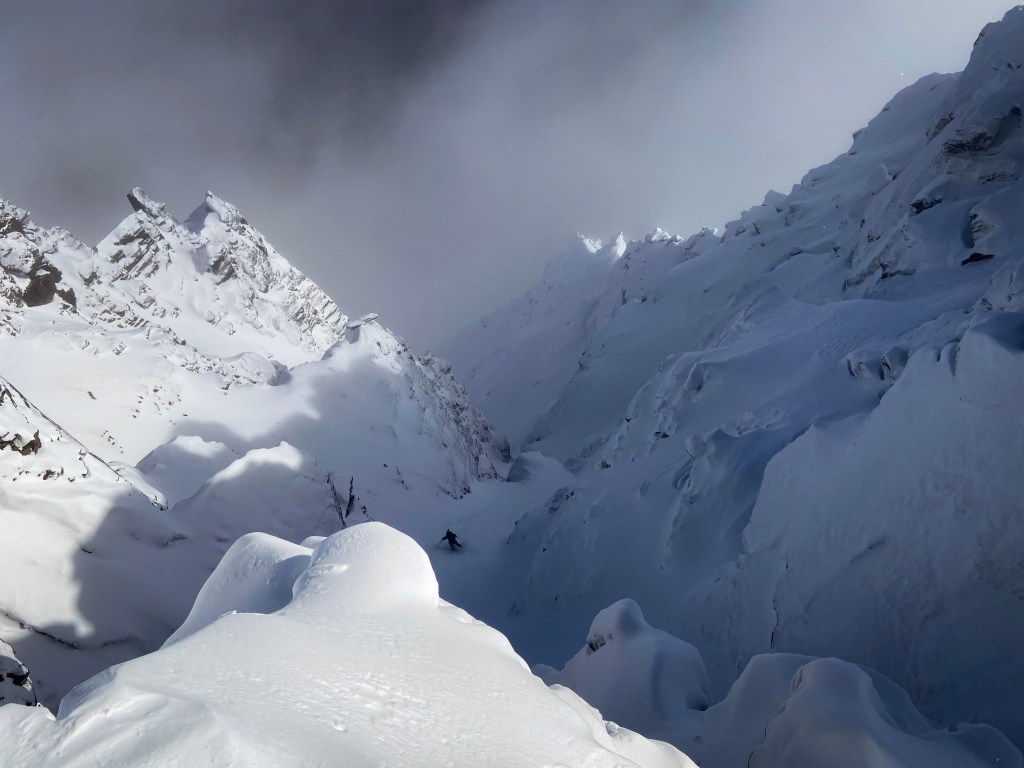
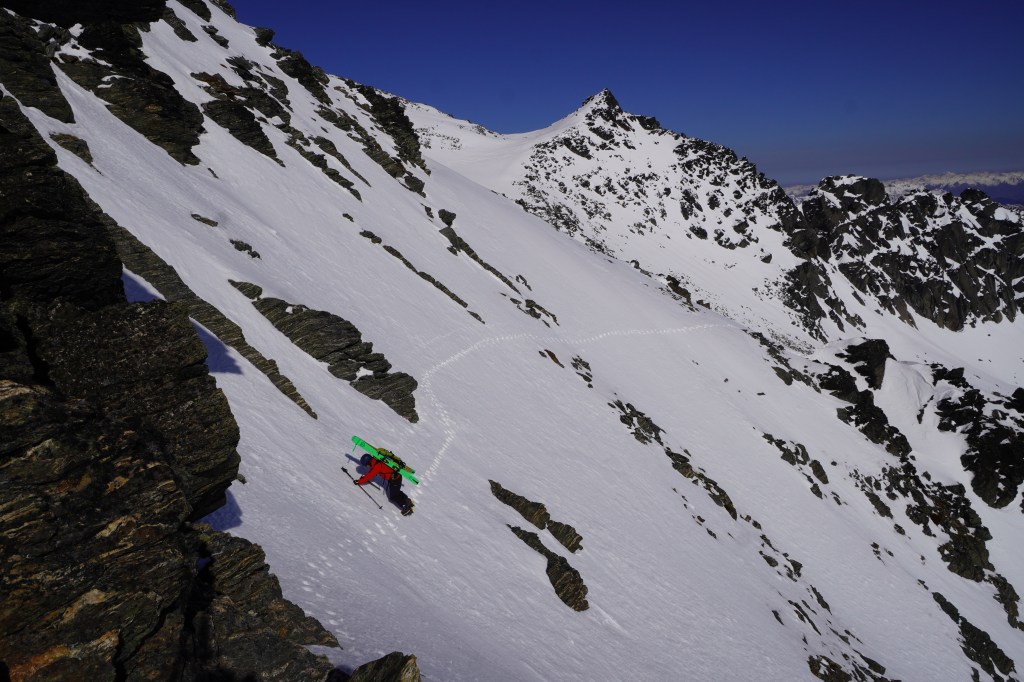
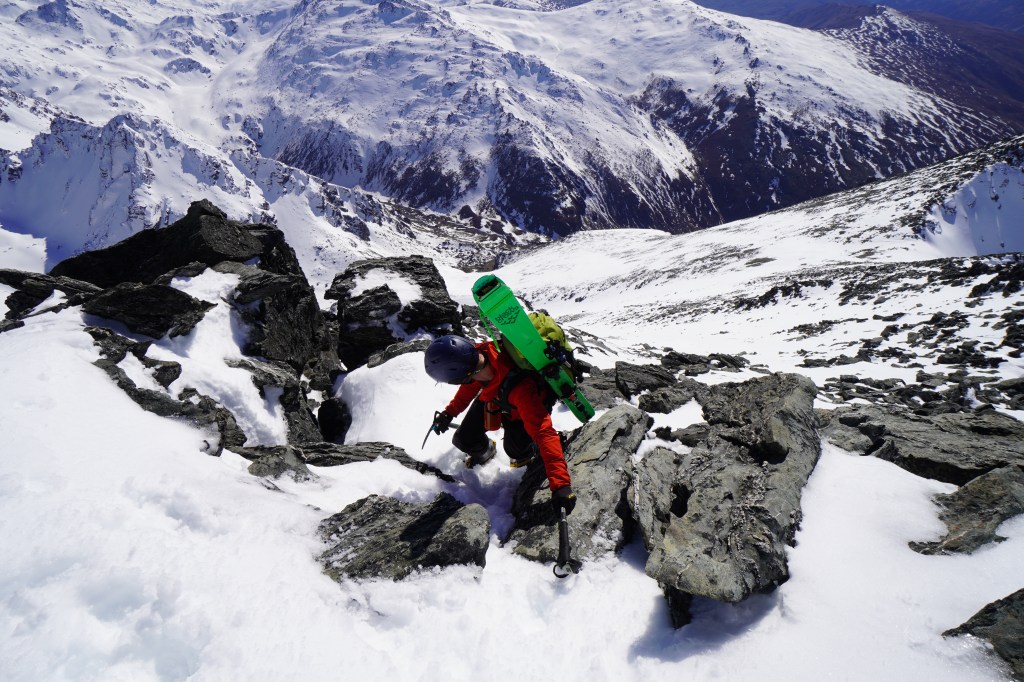
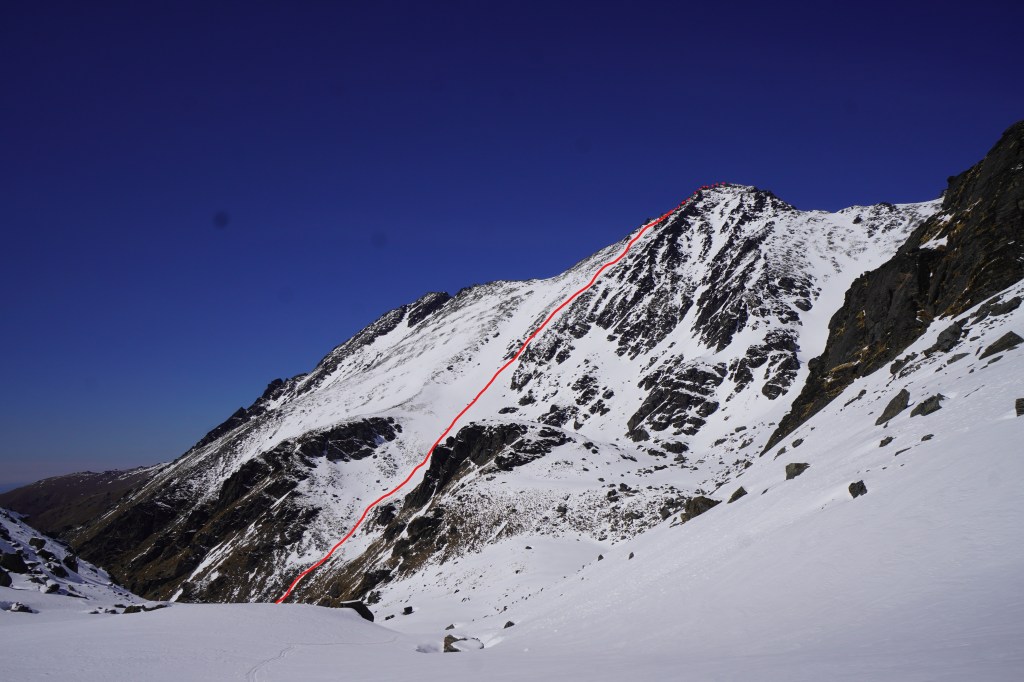
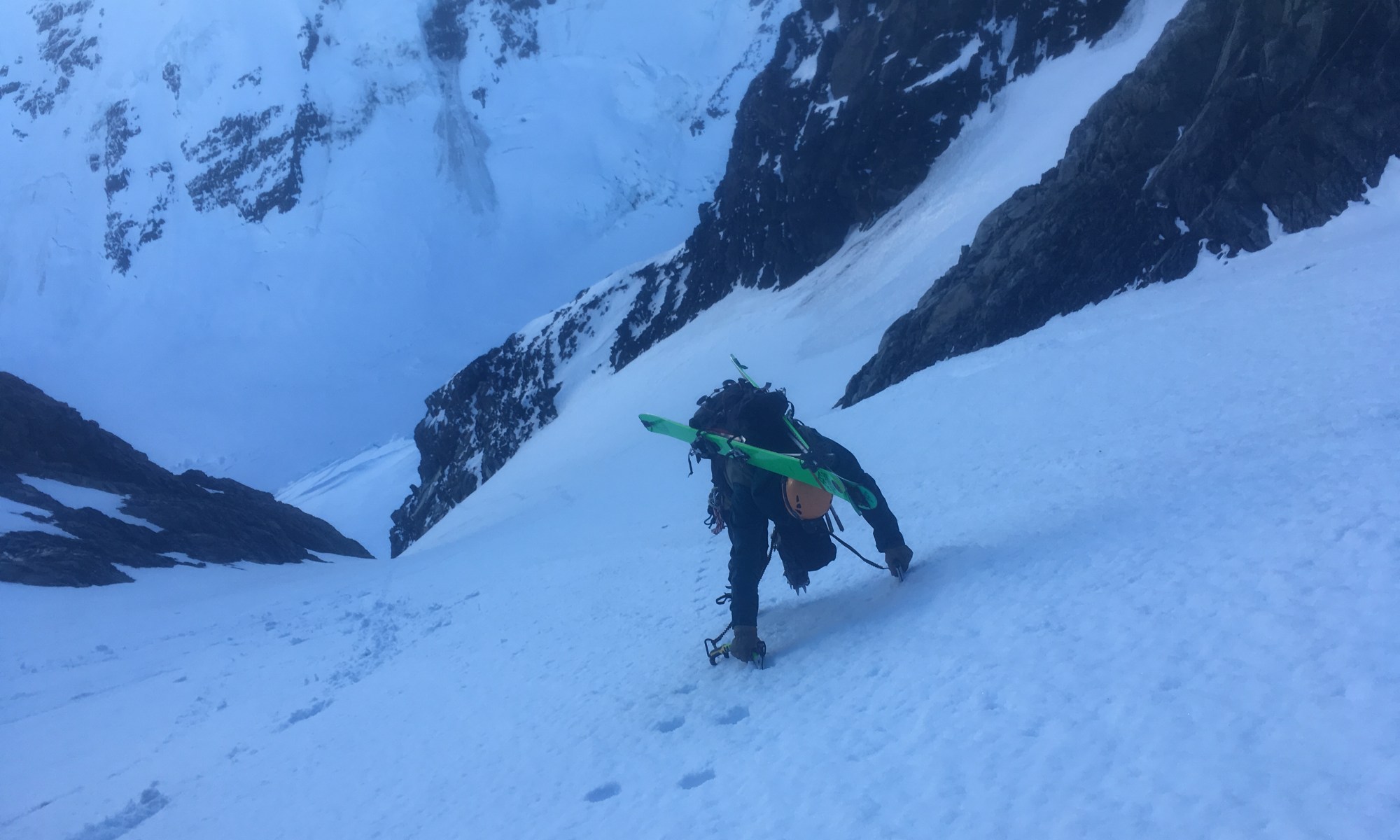
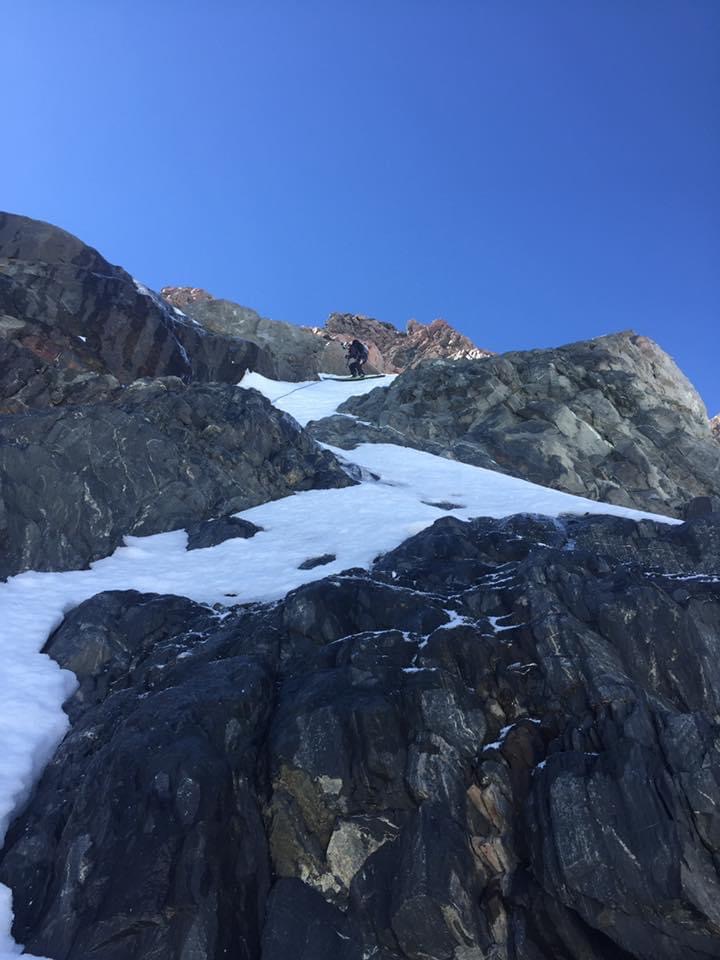
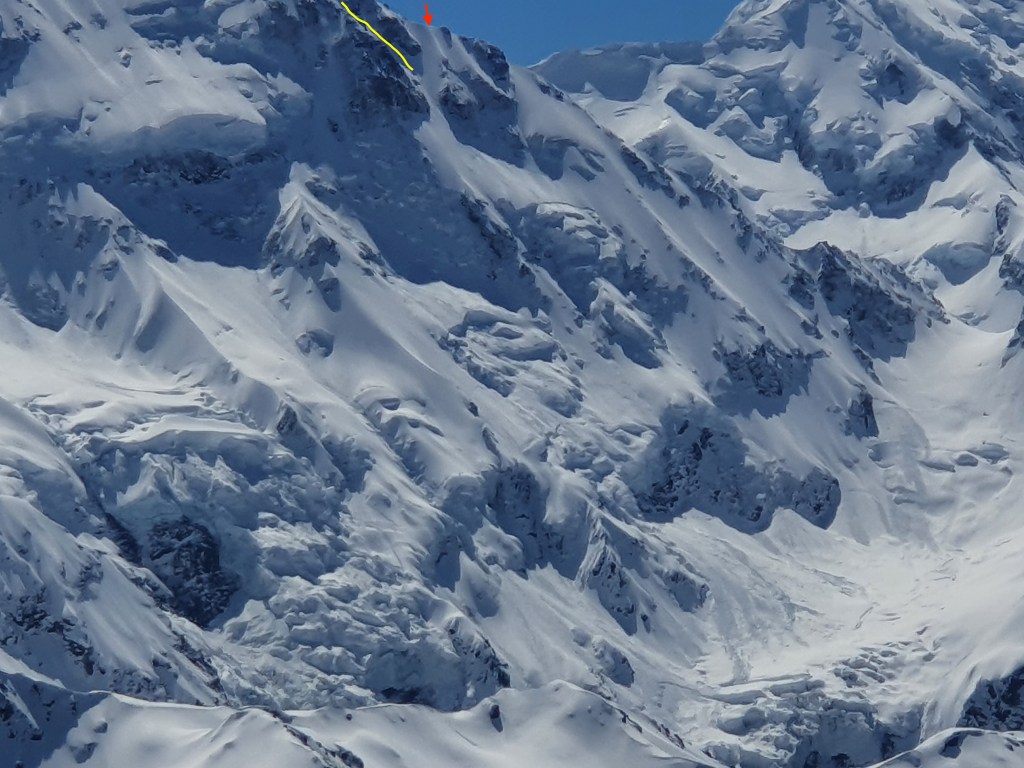
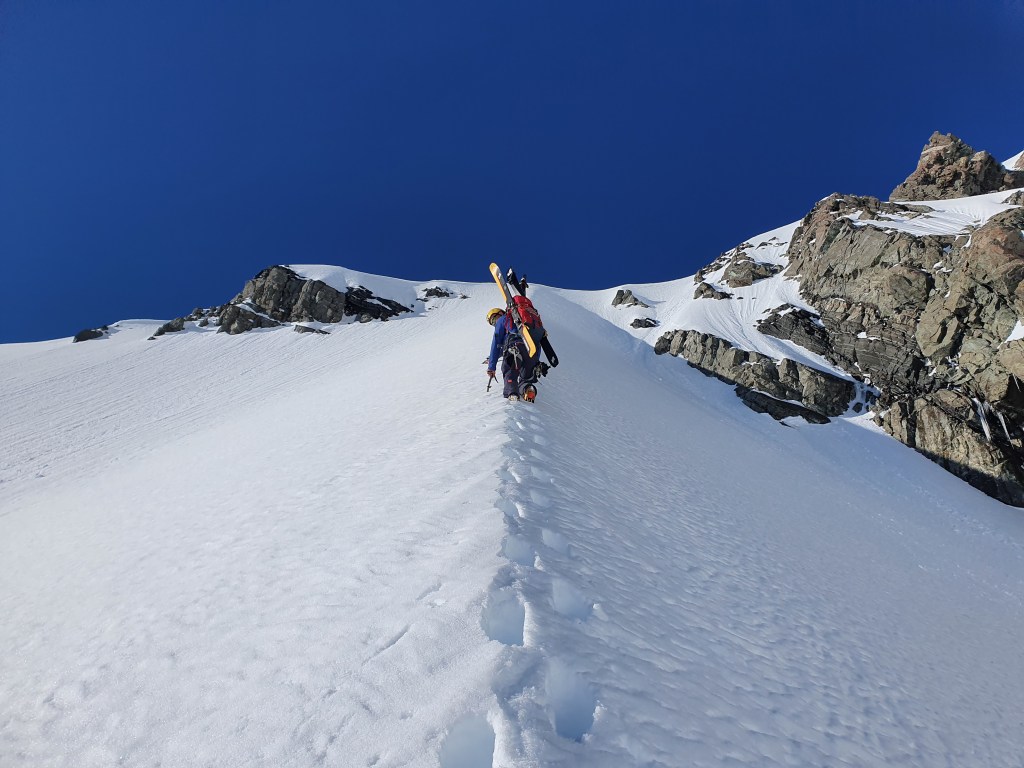
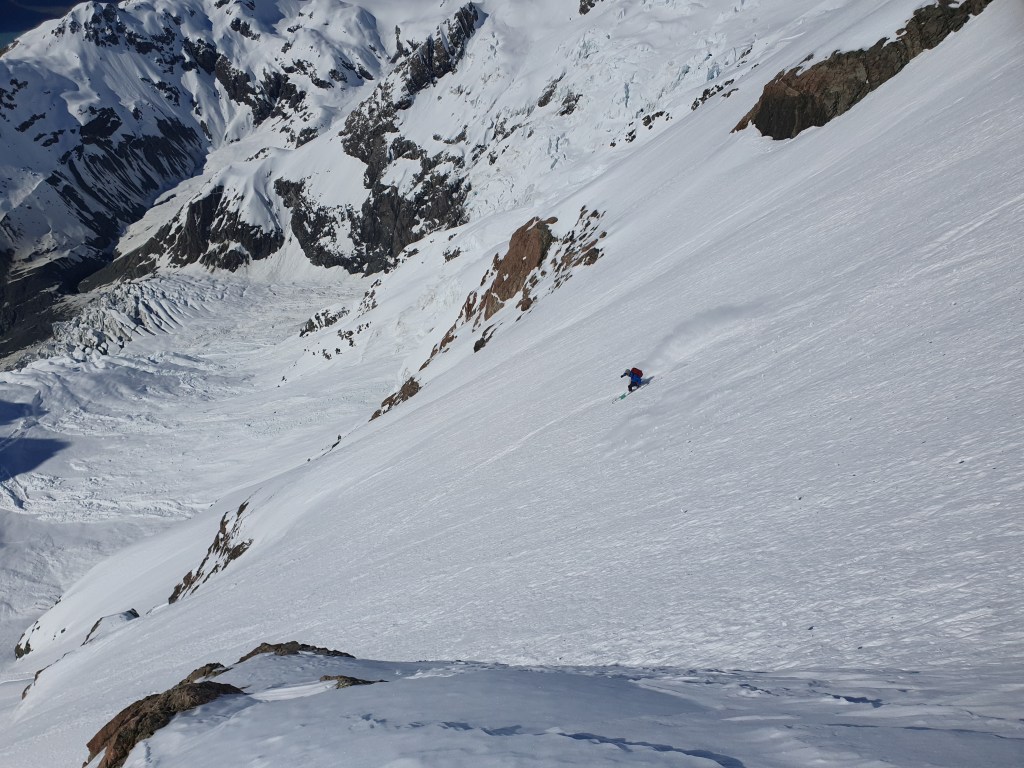
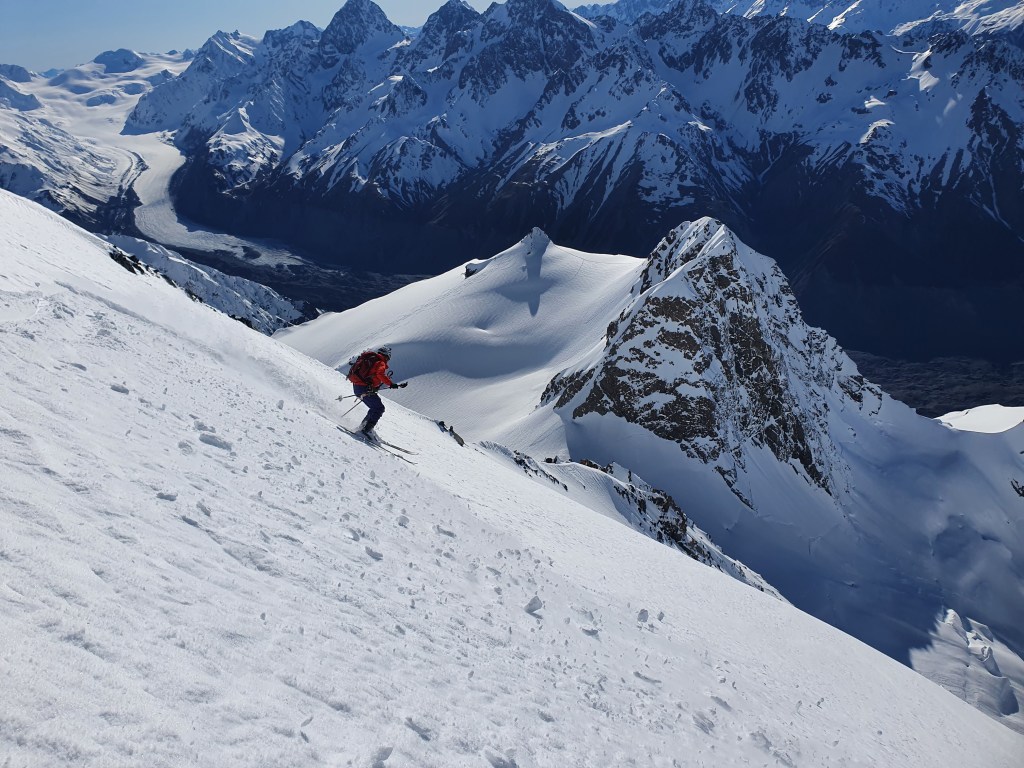
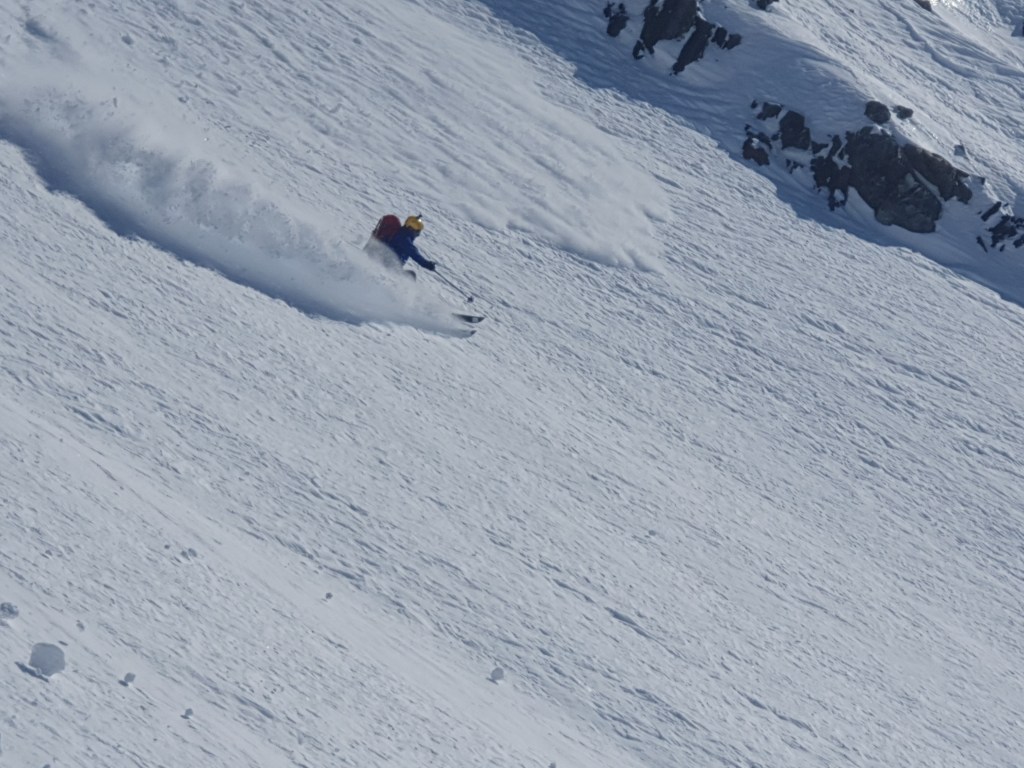
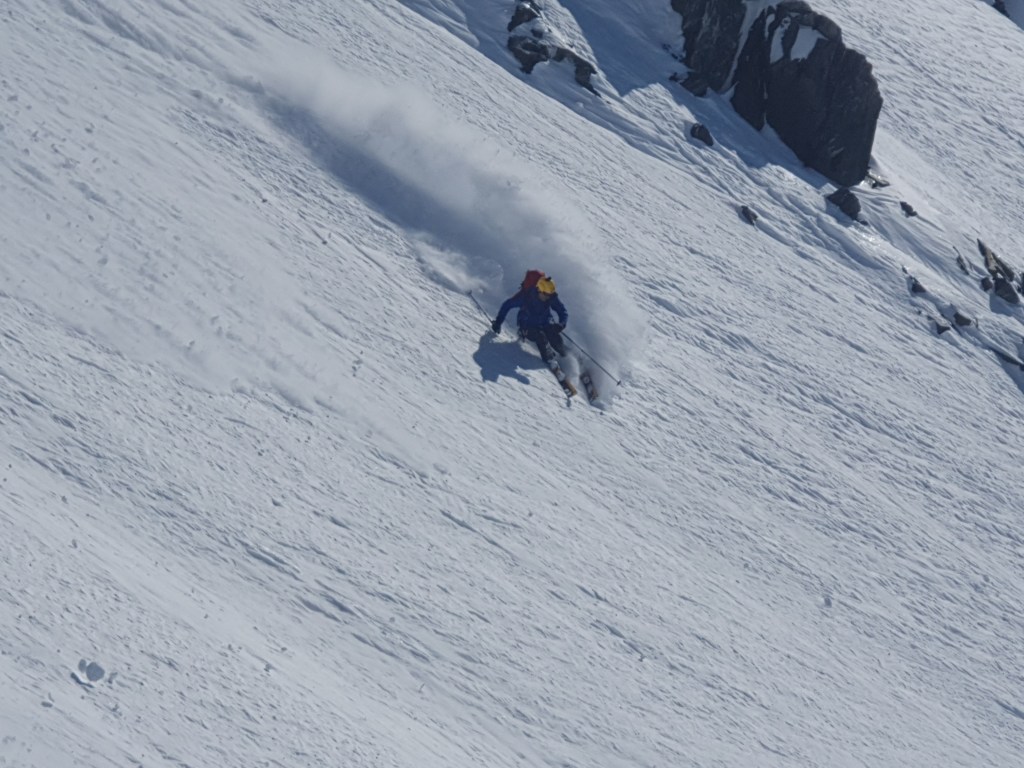
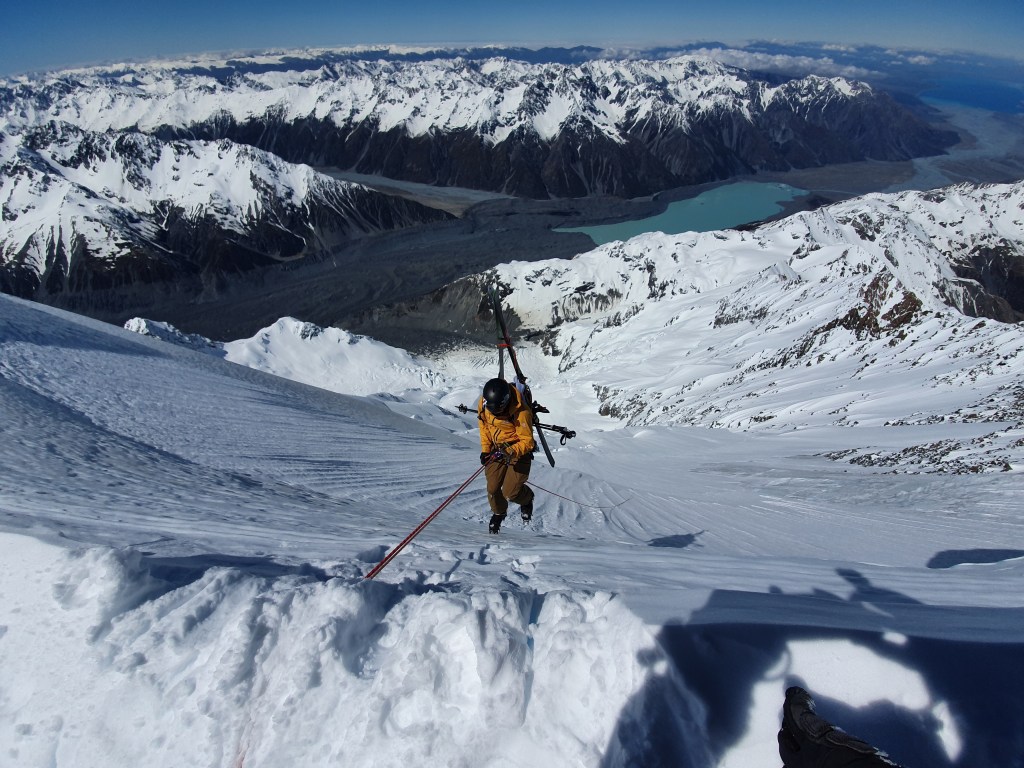
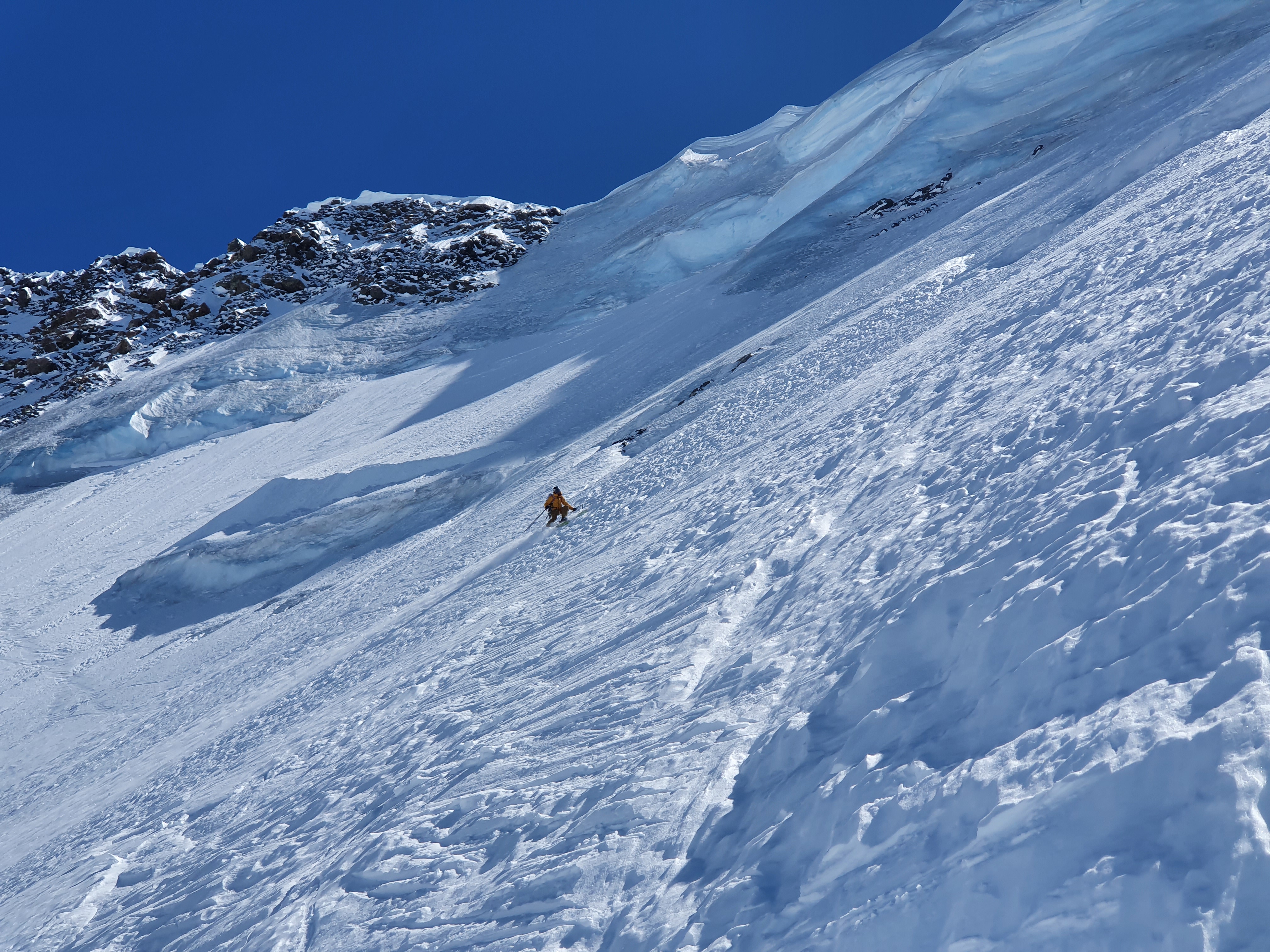
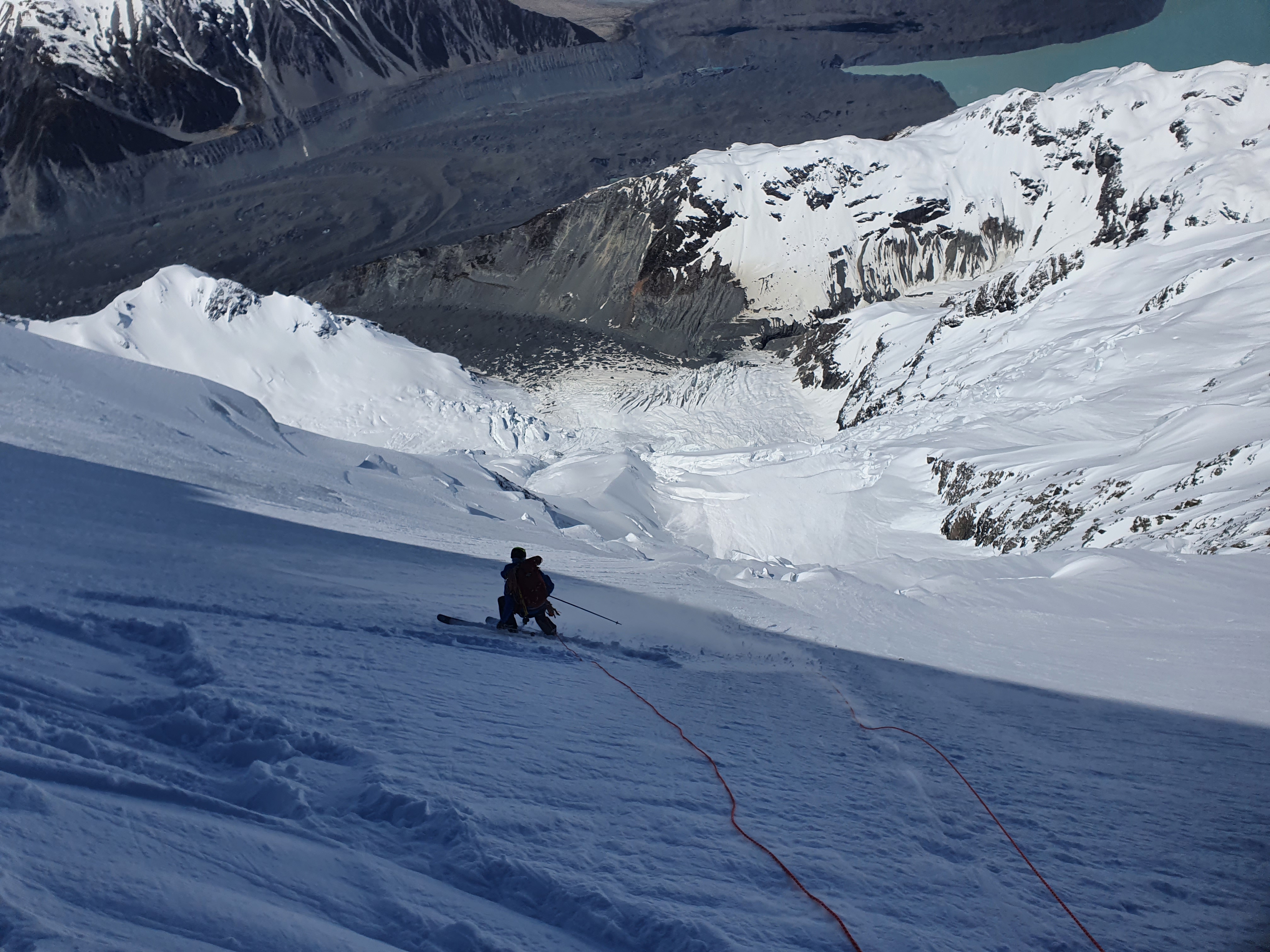
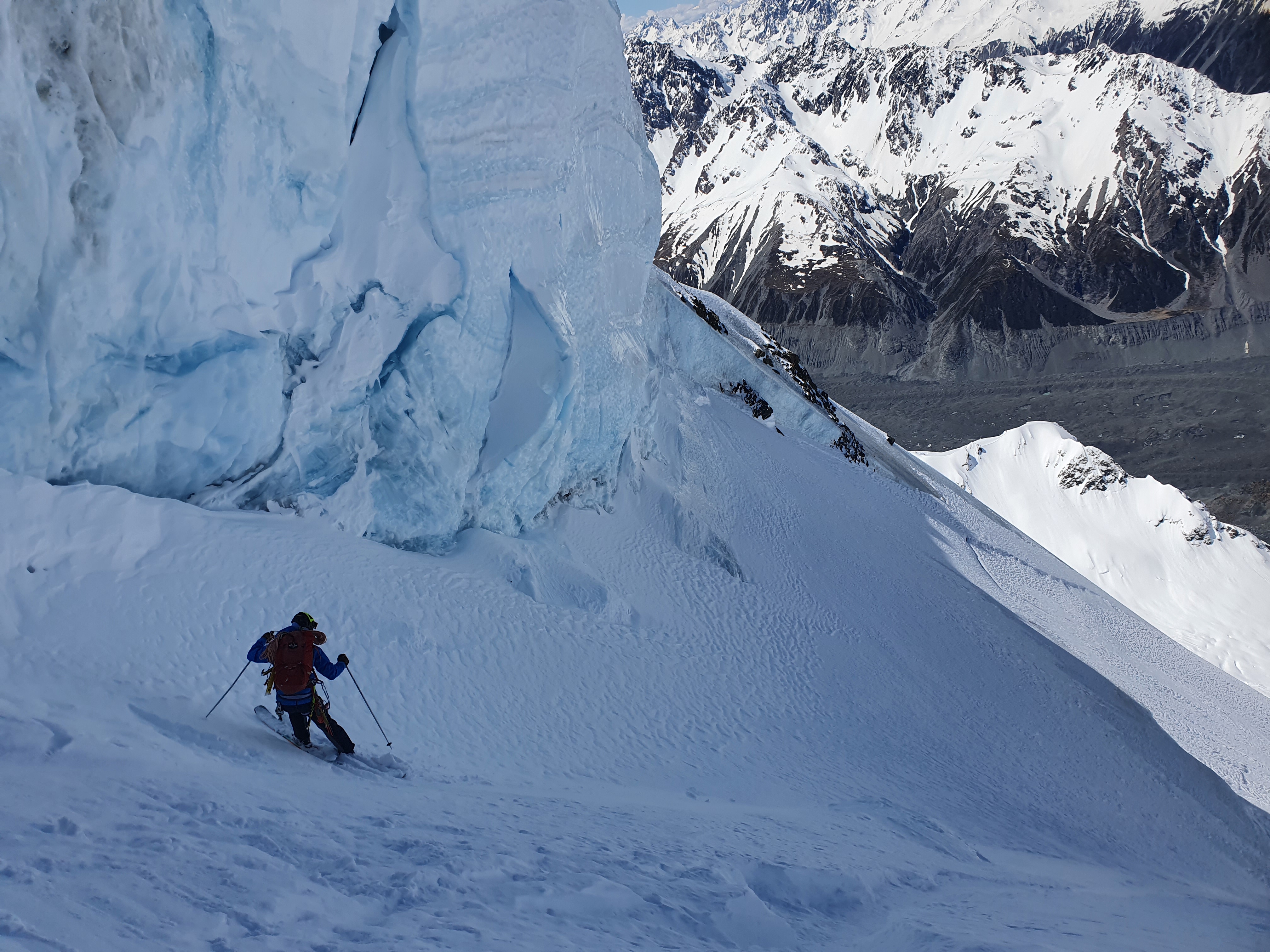
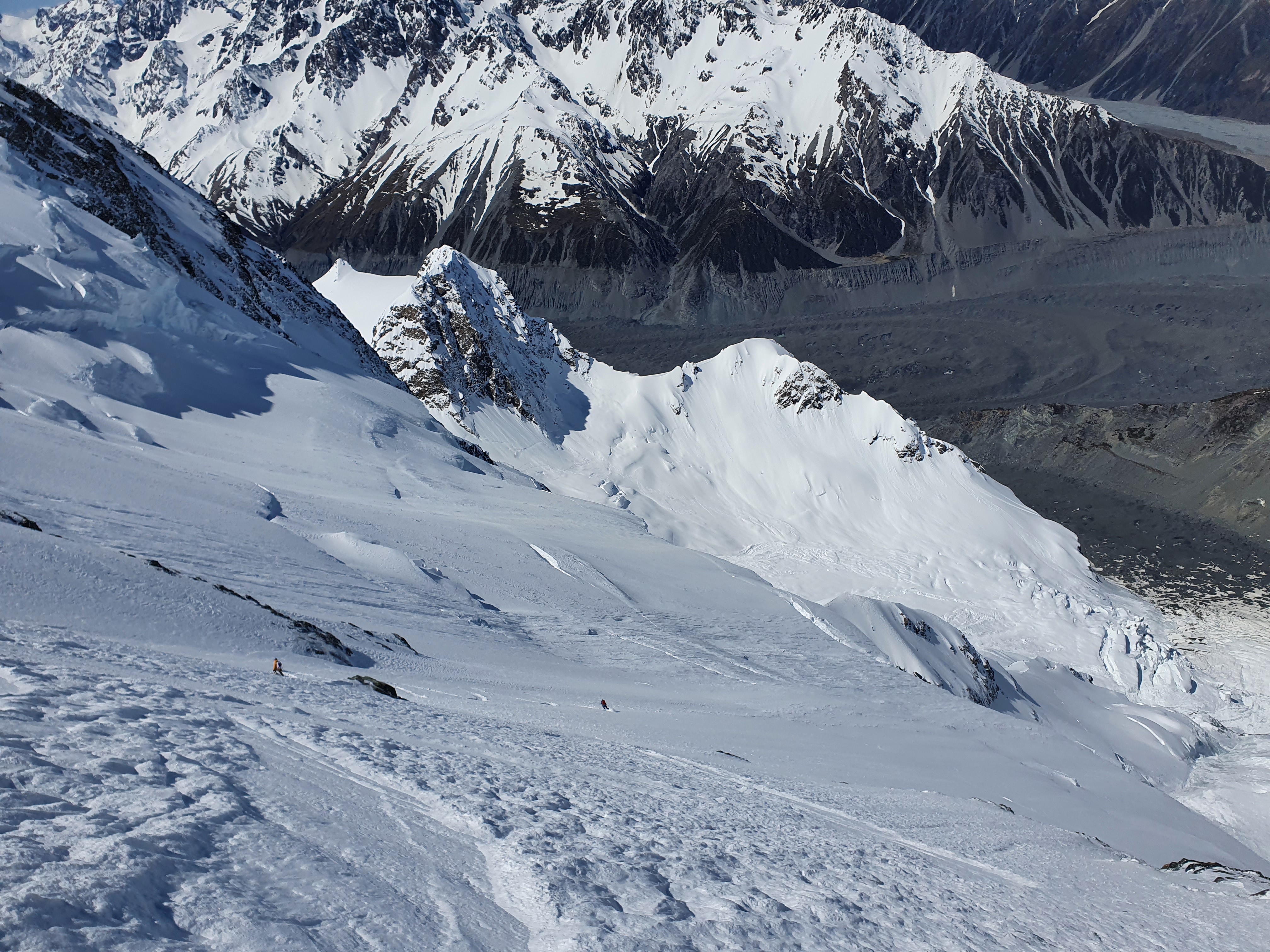
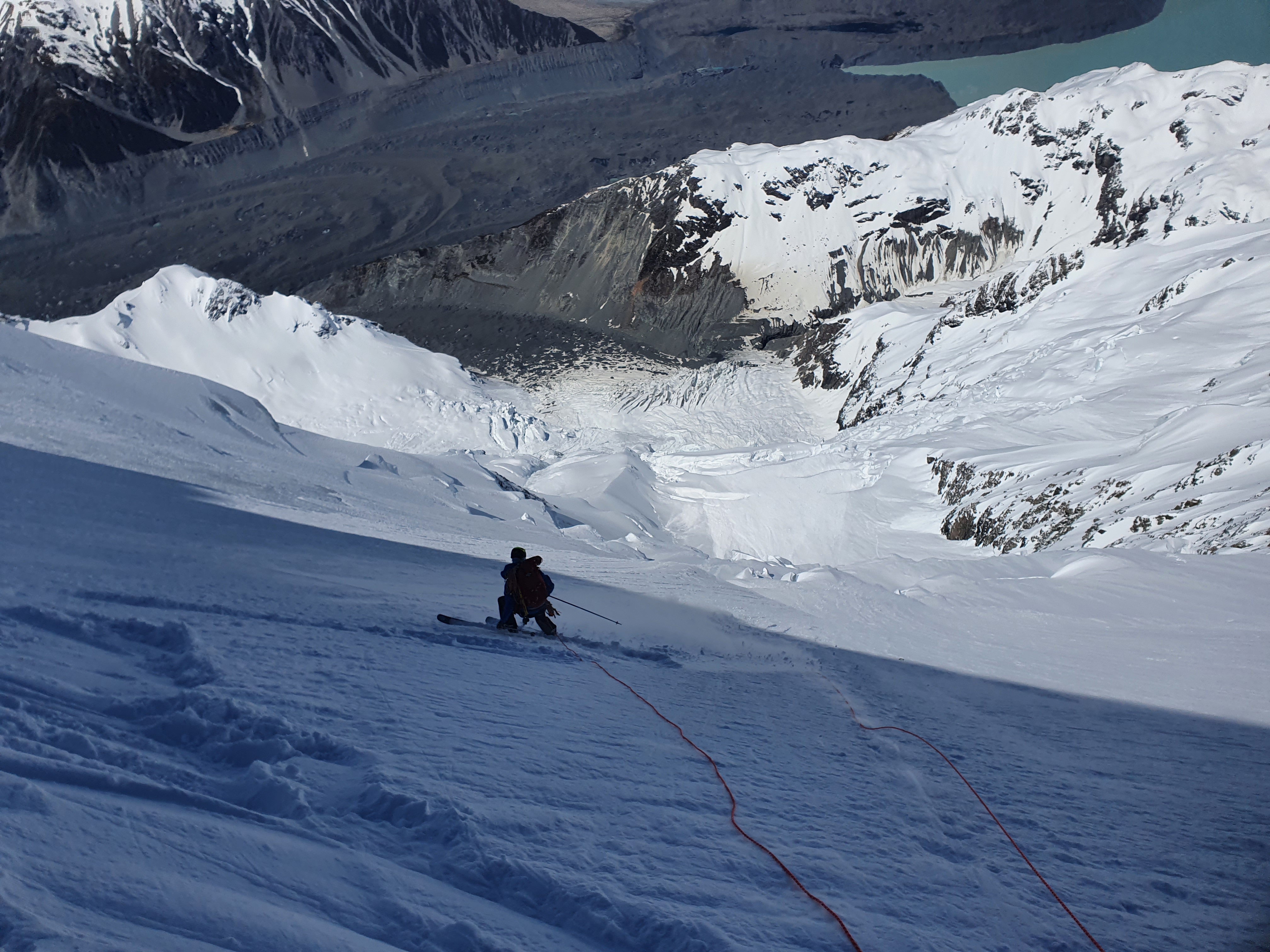
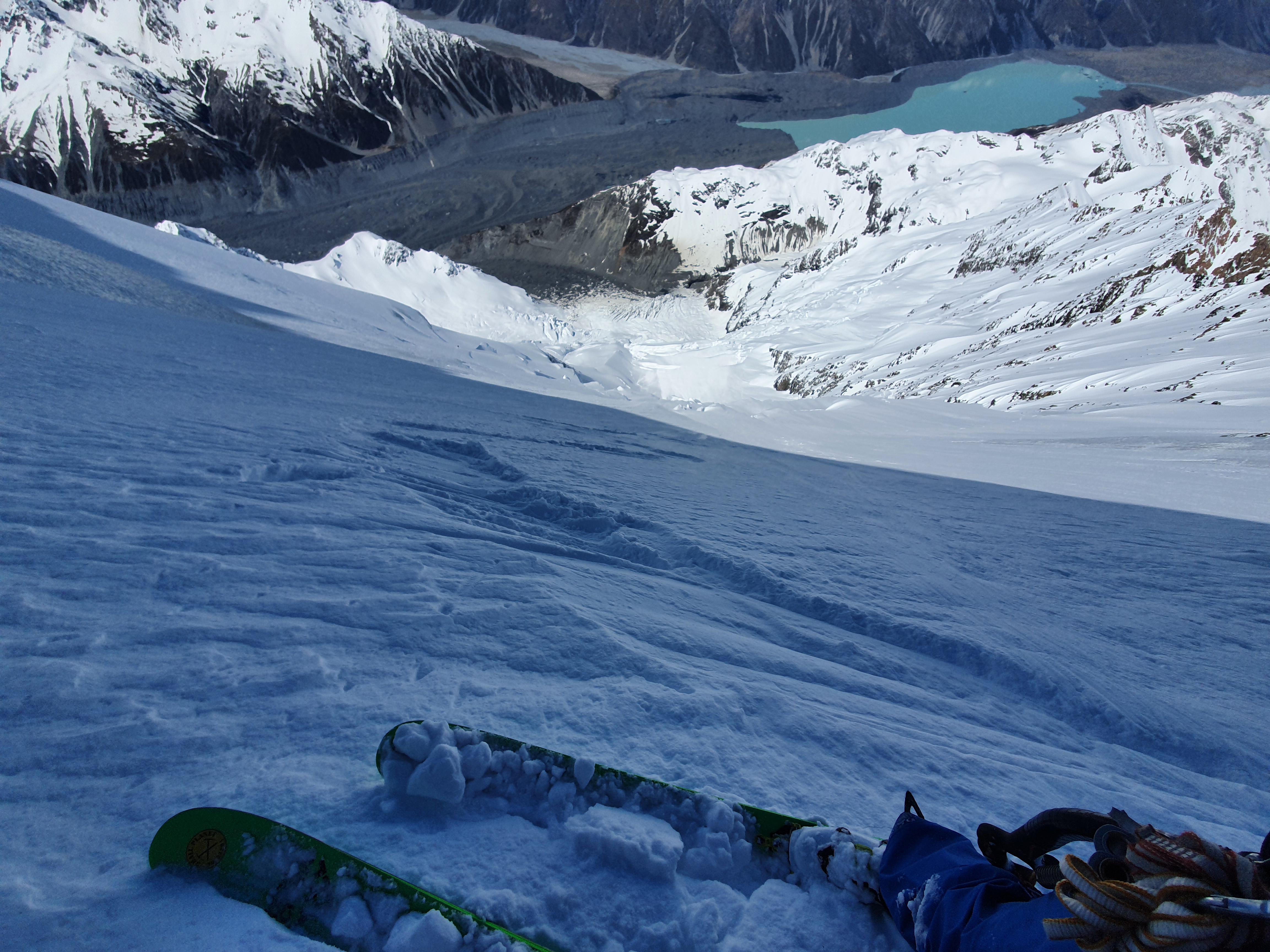
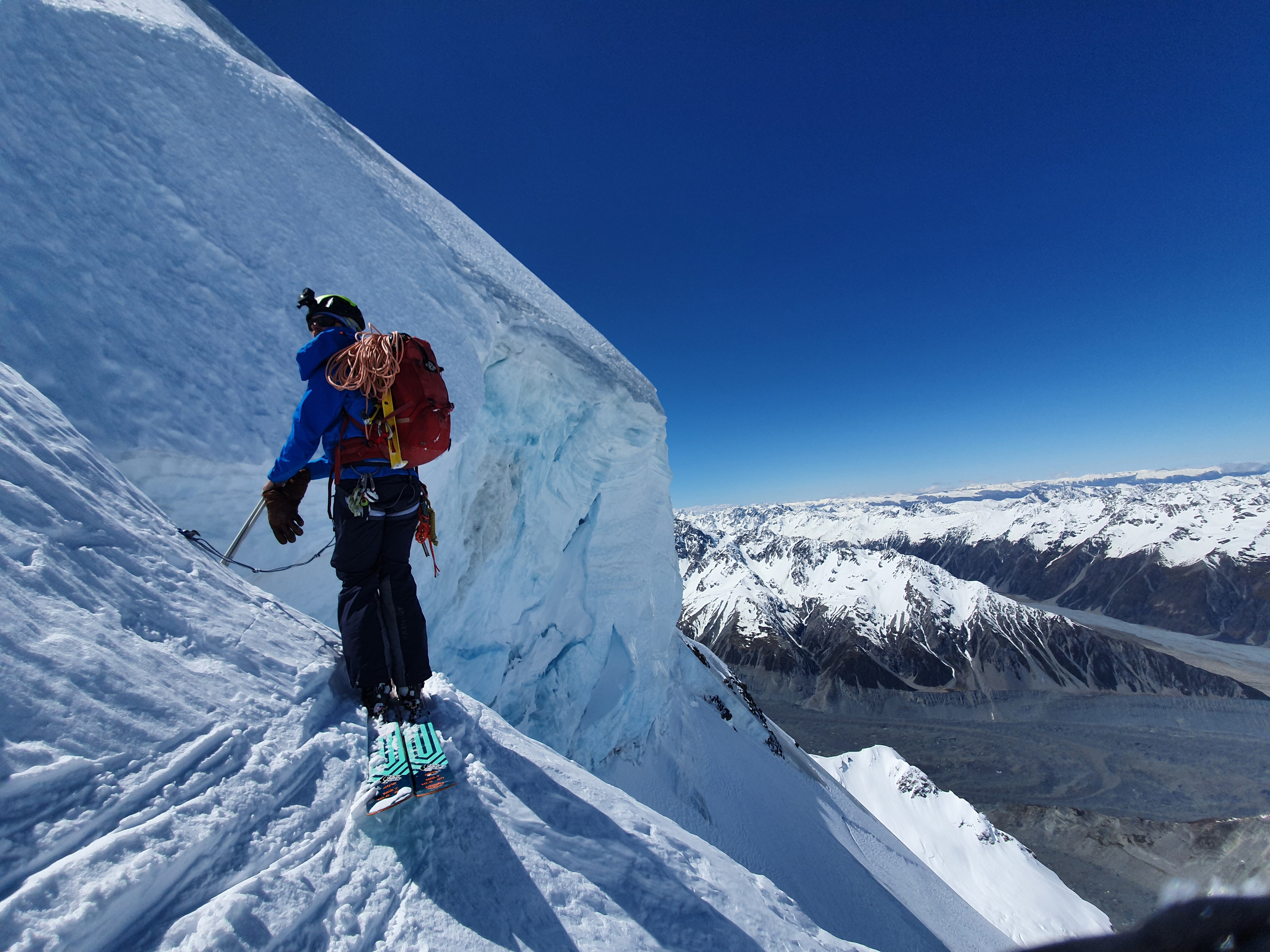
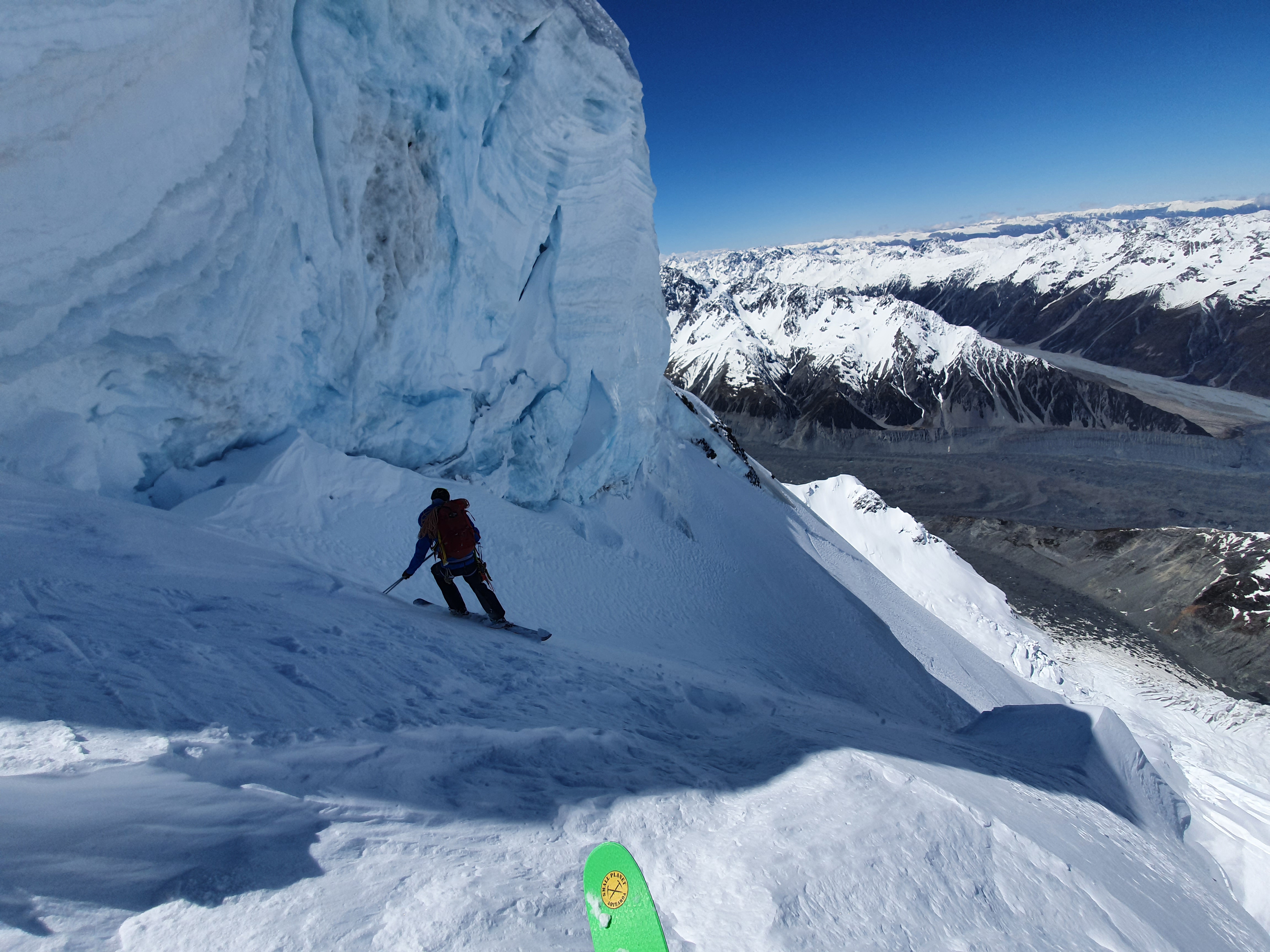
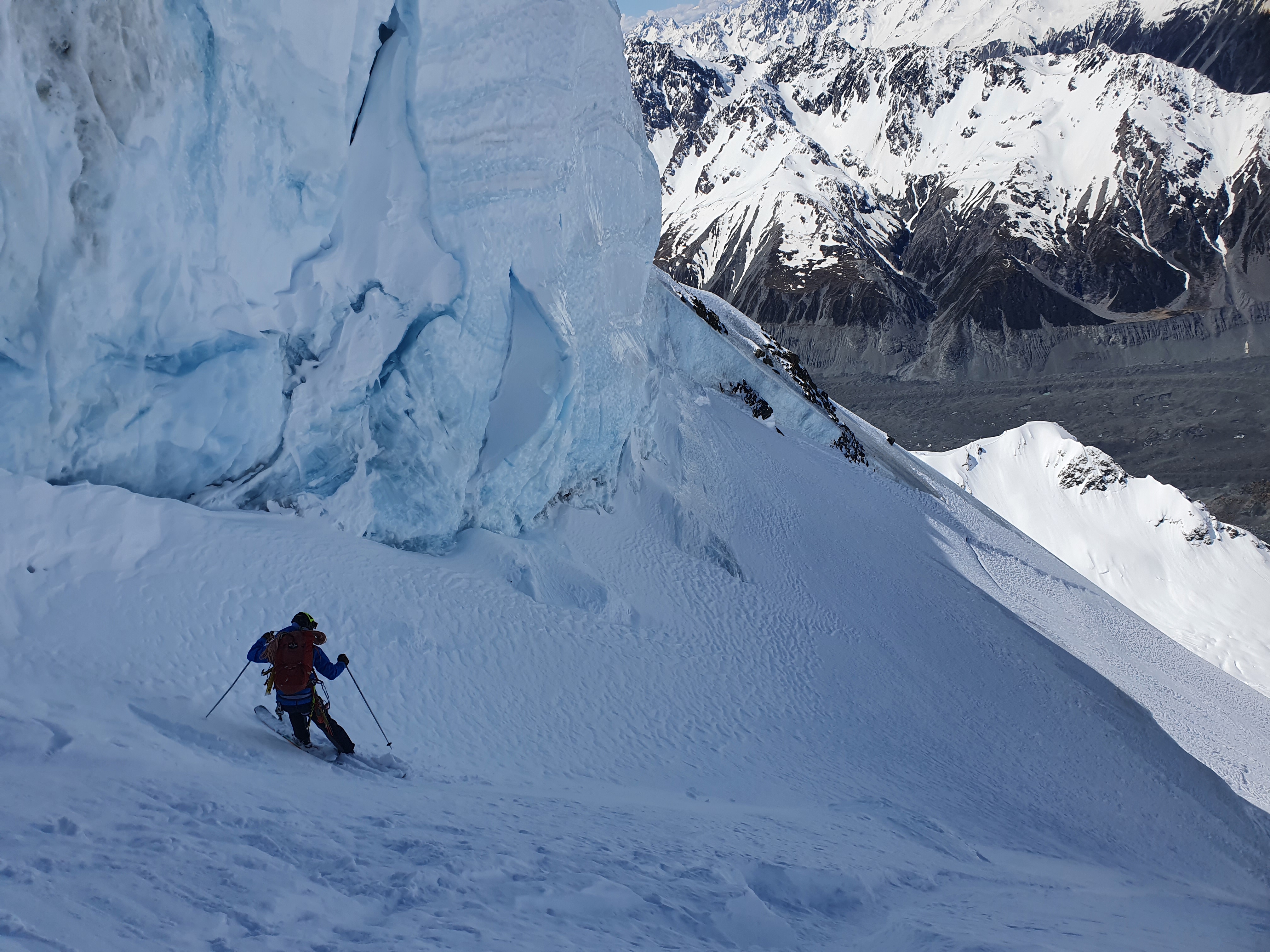
A classic moderate M3 mixed climb on the west face of the Remarks, previously unskiied. Back in July 2021, Maria and I had taken some friends there a few days earlier for an intro to mixed climbing, and as we were wallowing up the route through knee deep powder I got thinking this would be a great ski line. Luckily I was off work the next day so came back with the skis to open the line. Farily hectic line : short but technical and exposed at the top, with a mandatory air into the steepest narrowest part of the gully, just above another cliff band. High pressure stuff! Bumped into Grice who was working patrol and told him my plans and was keen to join me, but sadly couldn’t get out of work duties. But it did mean he was at the top of the line to take these rad photos! Chur!
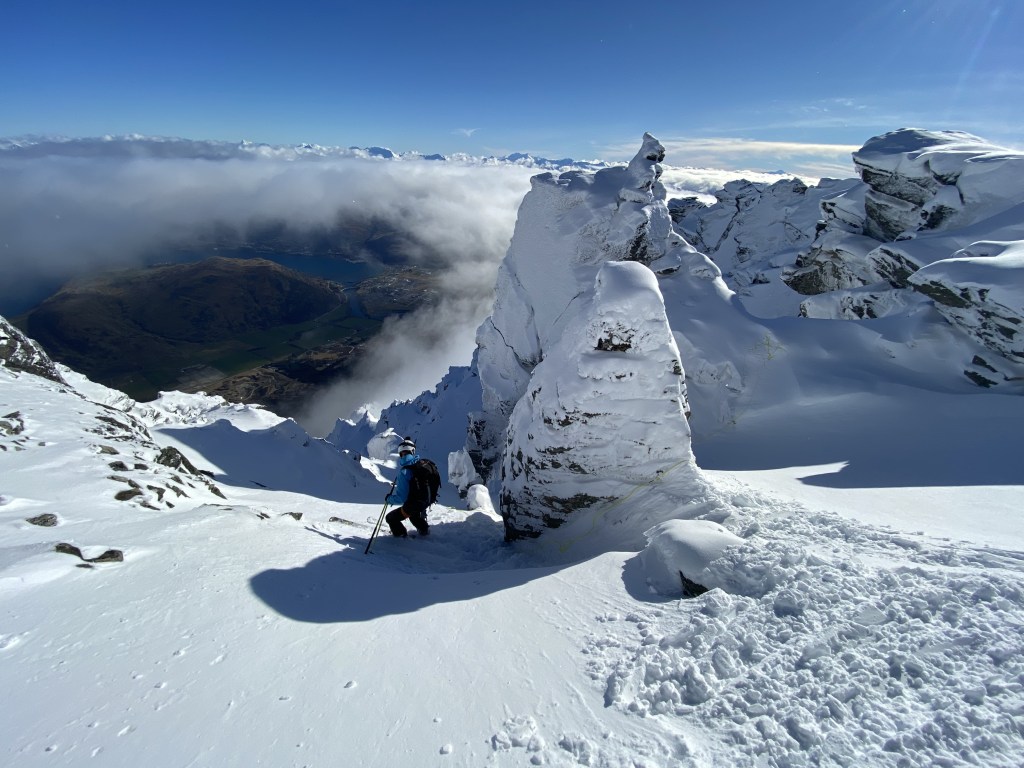
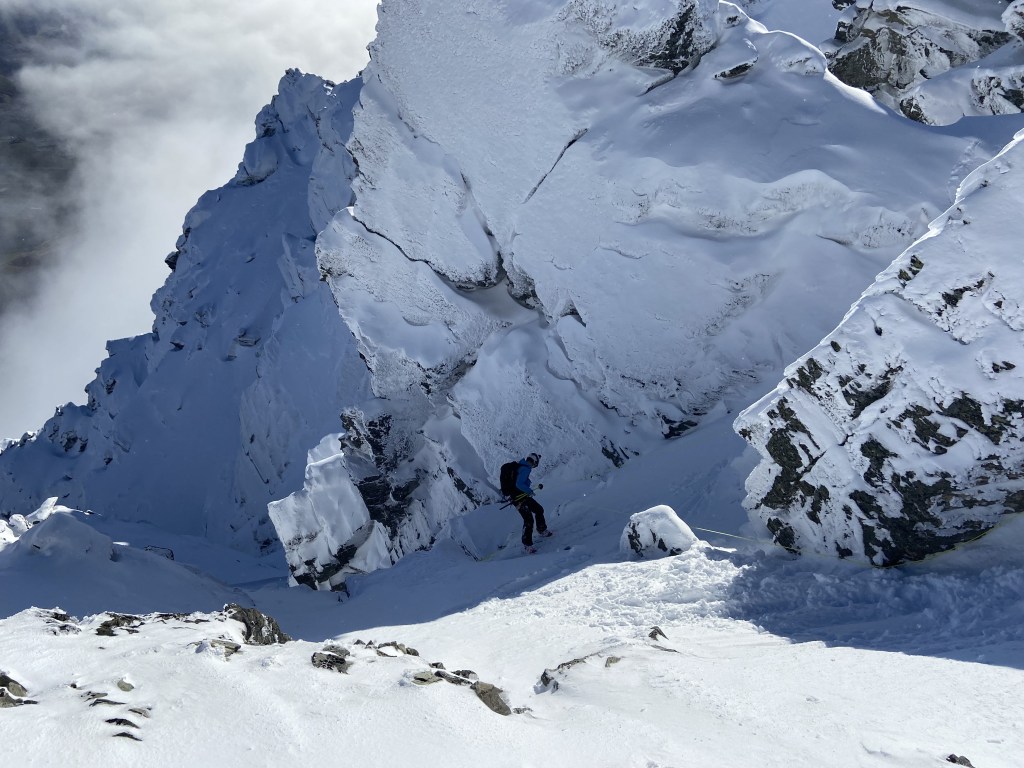
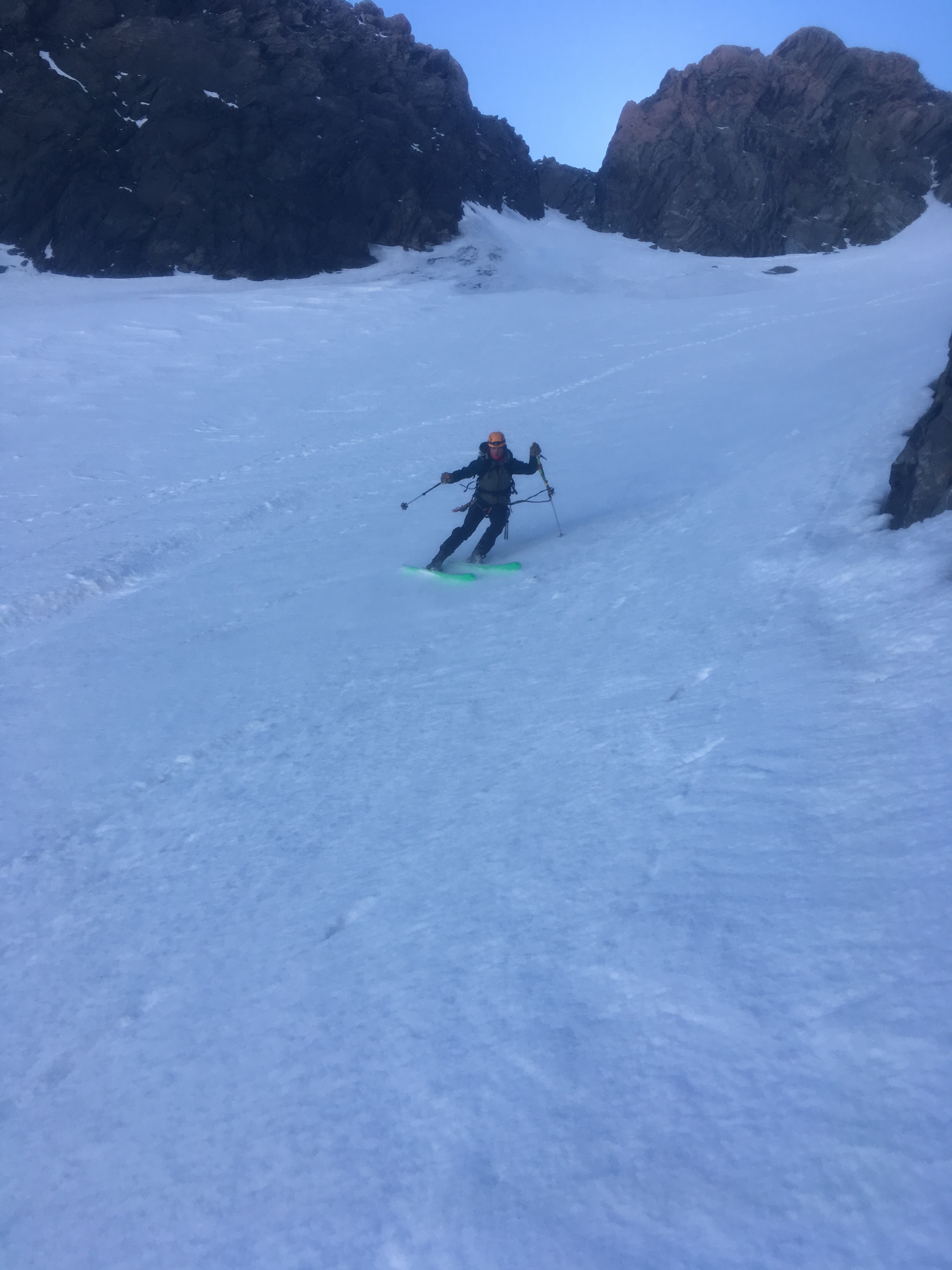
Skiing the top section of MK gully, above the mandatory airStanding at the entry to MK gully. Block to the right is good to rap off
Length – The climbing route to Queens Drive is 150m. But you can keep going beyond there until the snow runs out, I made it about another 300m.
Steepness – Initially around 40-45. After the air its steep (around 45-50) and you havent got long to control your speed before the next drop
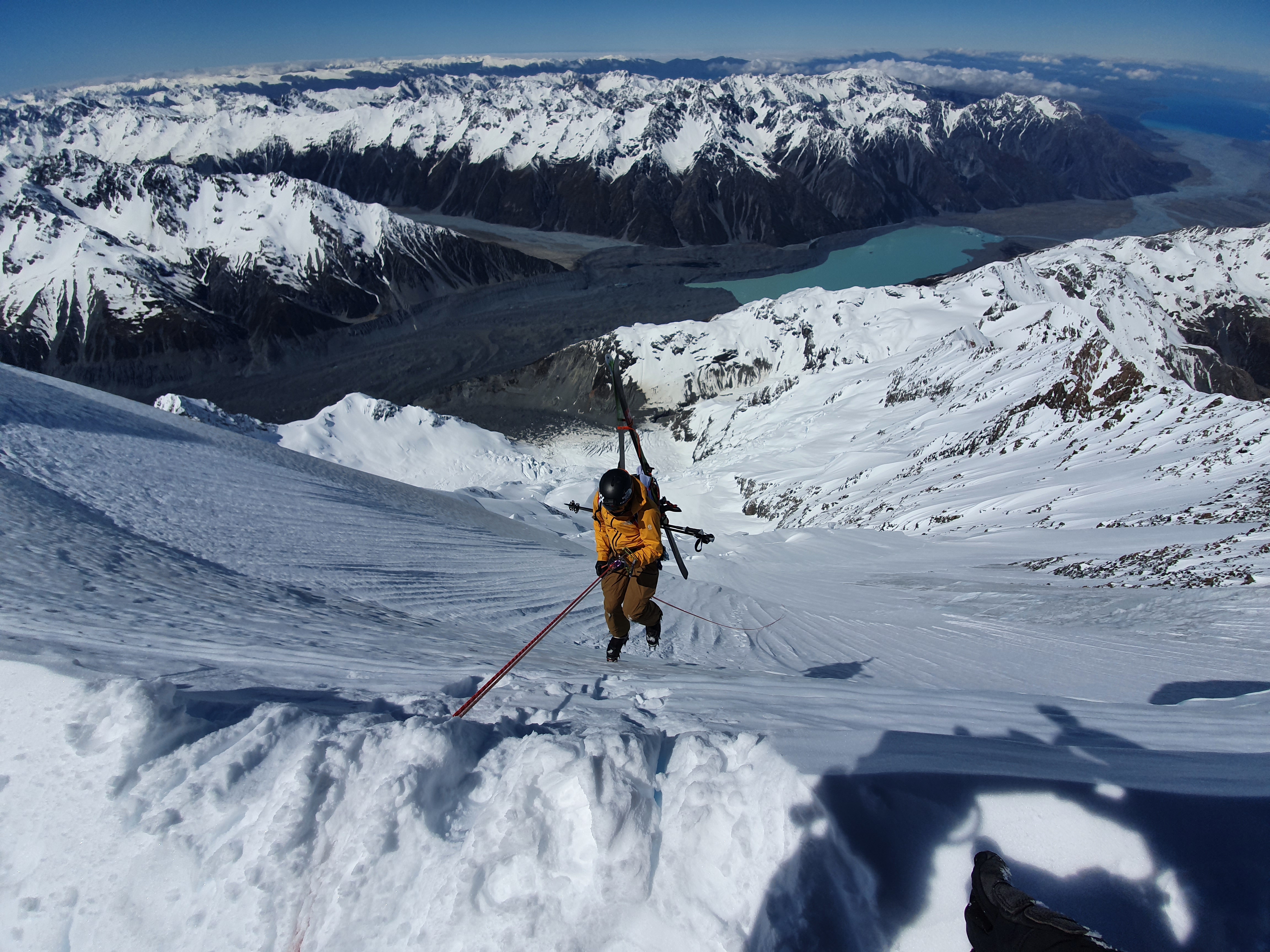
Exposure – Critical in the top section. Gets its M3 grade from several vertical rock steps which are linked by snow ramps. Once your through this your cruising
Aspect – West
Difficulty – 5.2 E3. Difficulty really all comes in sticking the air and controlling your speed in the narrow and steep mid section before the next cliff. Falling on the landing would cause a really nasty tumble through the next cliff band
Equipment – 60m rad line. Crampons and 1x tool. Picket and rap tat
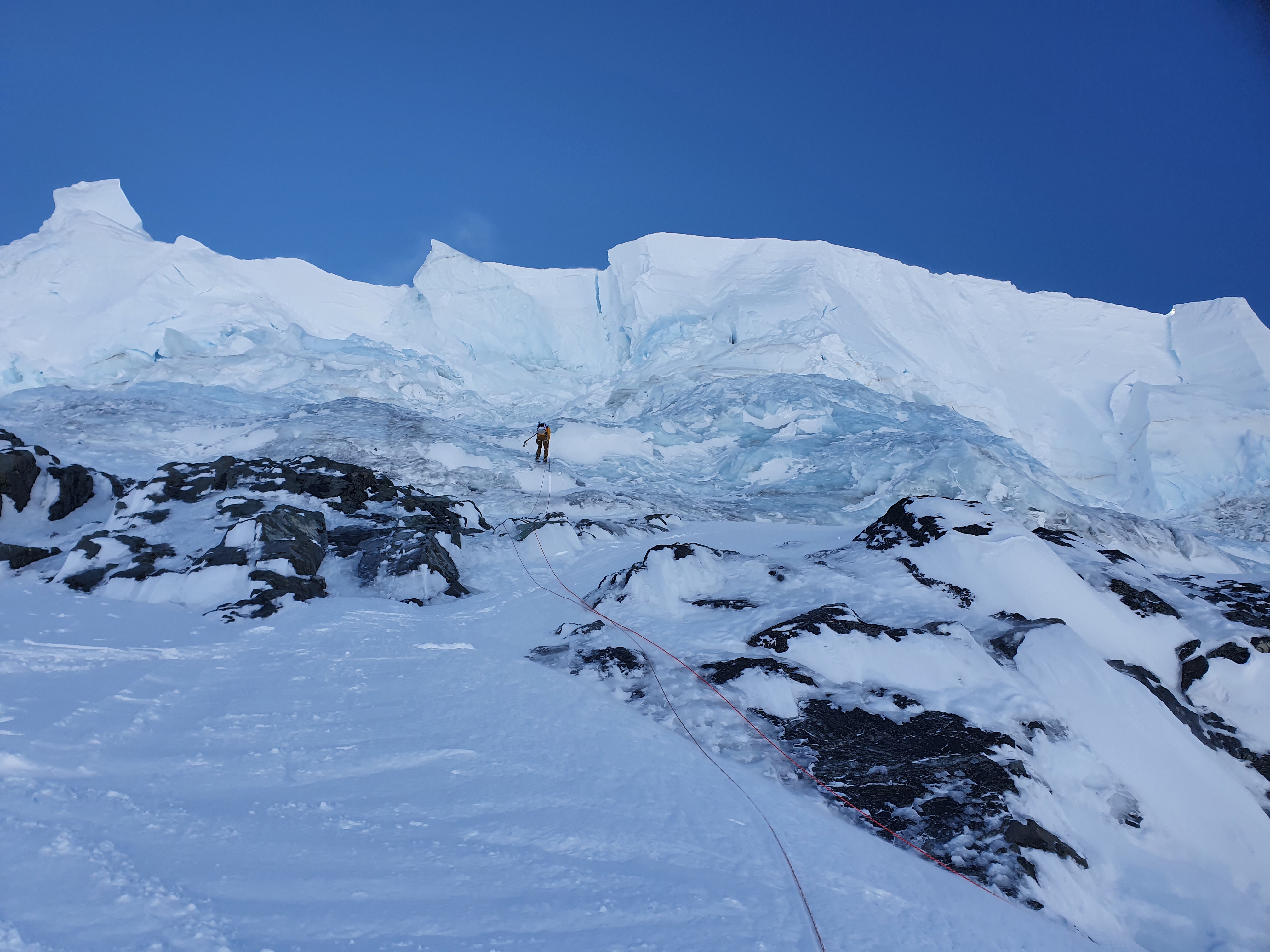
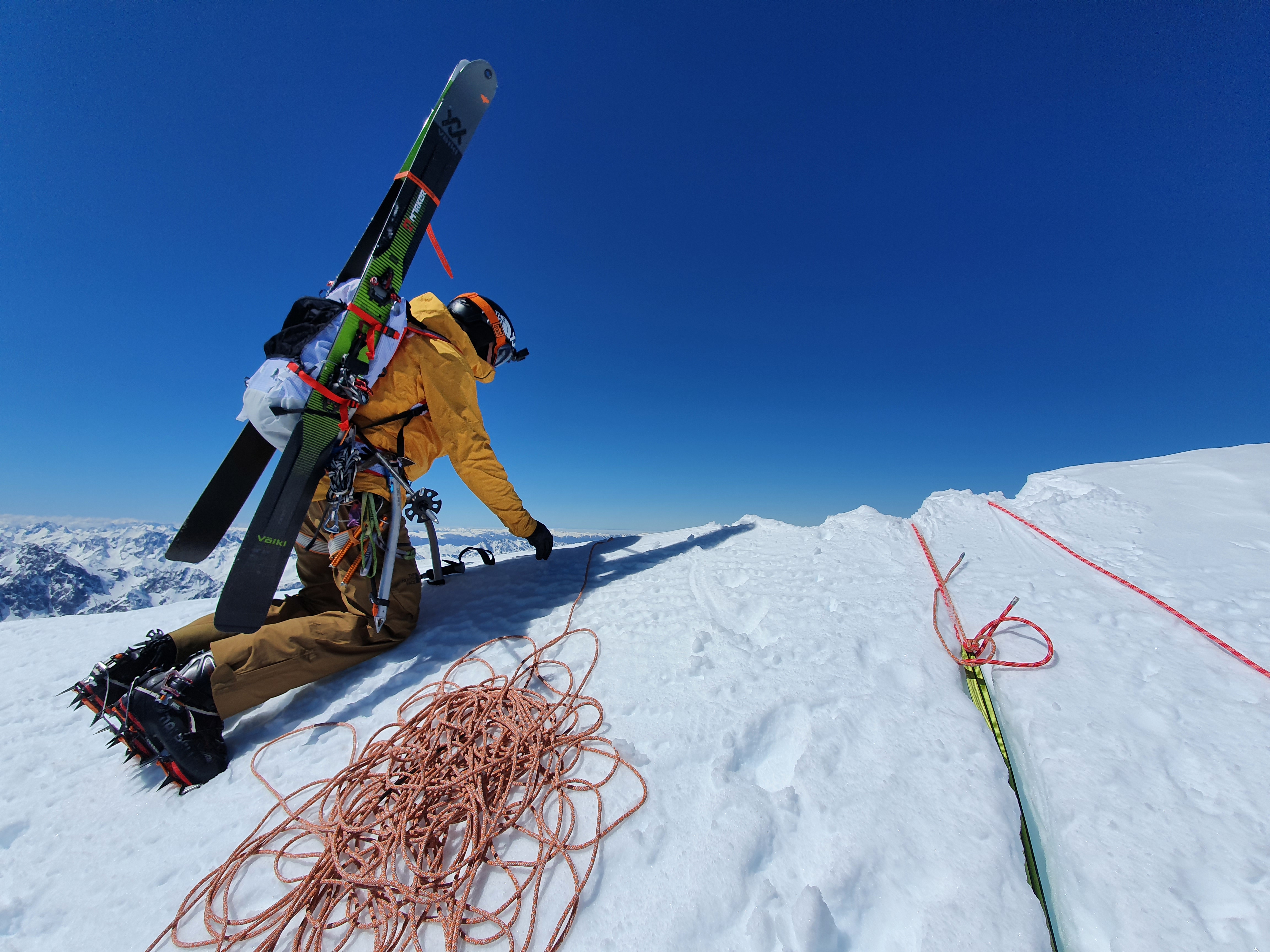
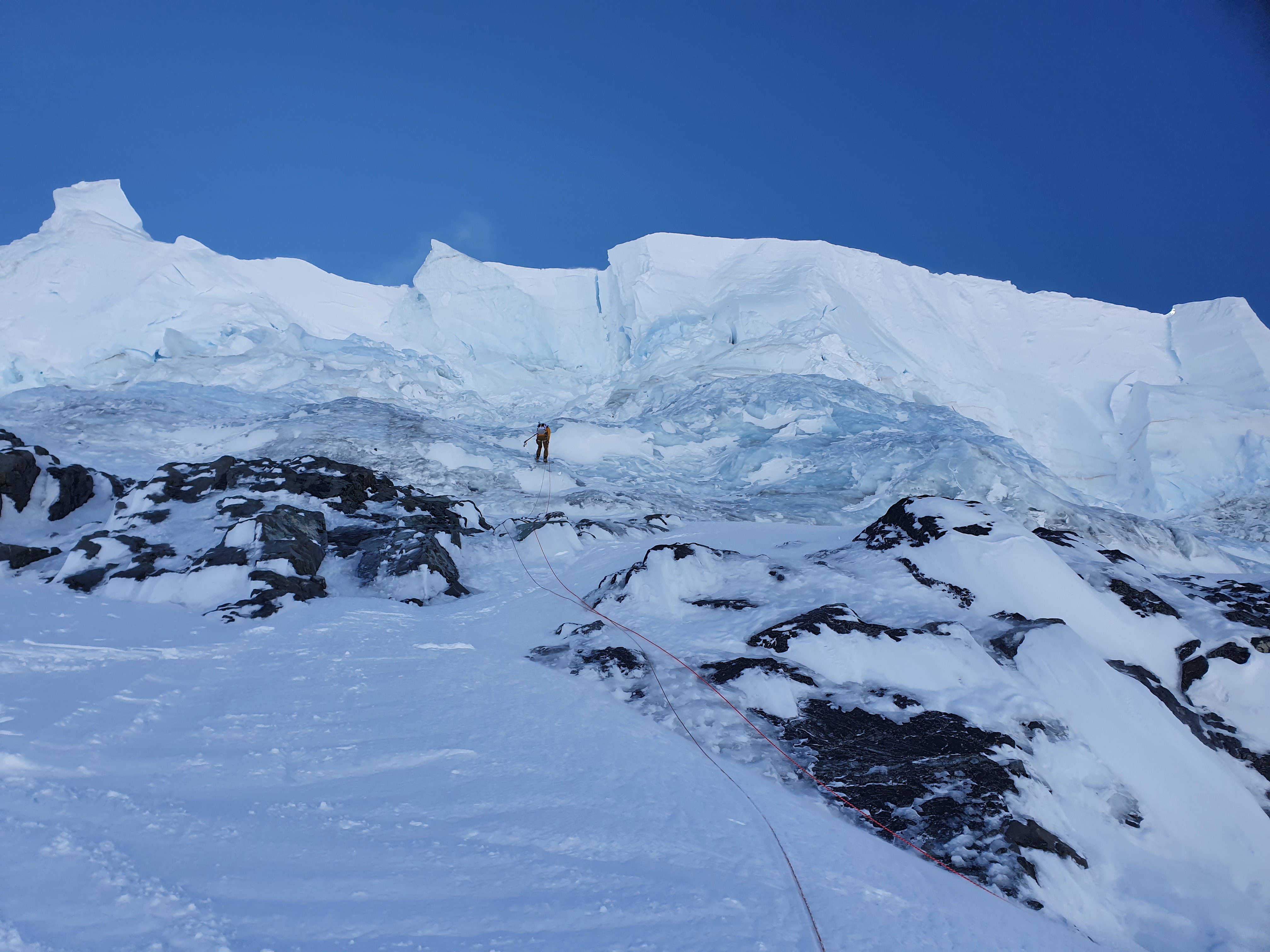
Got the rope out right at the top to get into the main part of the line.
As with all of these climbing lines, its critical to check theres nobody coming up the route before you start skiing it.
Start by going up Shadow chair and head up past the chutes across the top of diangulator all the way up to the ridgeline. The top of MK is just in front of you at a flat section. The climb has several different topouts – the furthest skiiers left is the most skiiable. The large block in the above photo is the best landmark to ID it, and also works well as a rap anchor. I rapped about 5m over the rocks at the top – after getting through it and seeing the snow on the other side, it totally would have gone to just jump the rocks. Maybe next time!
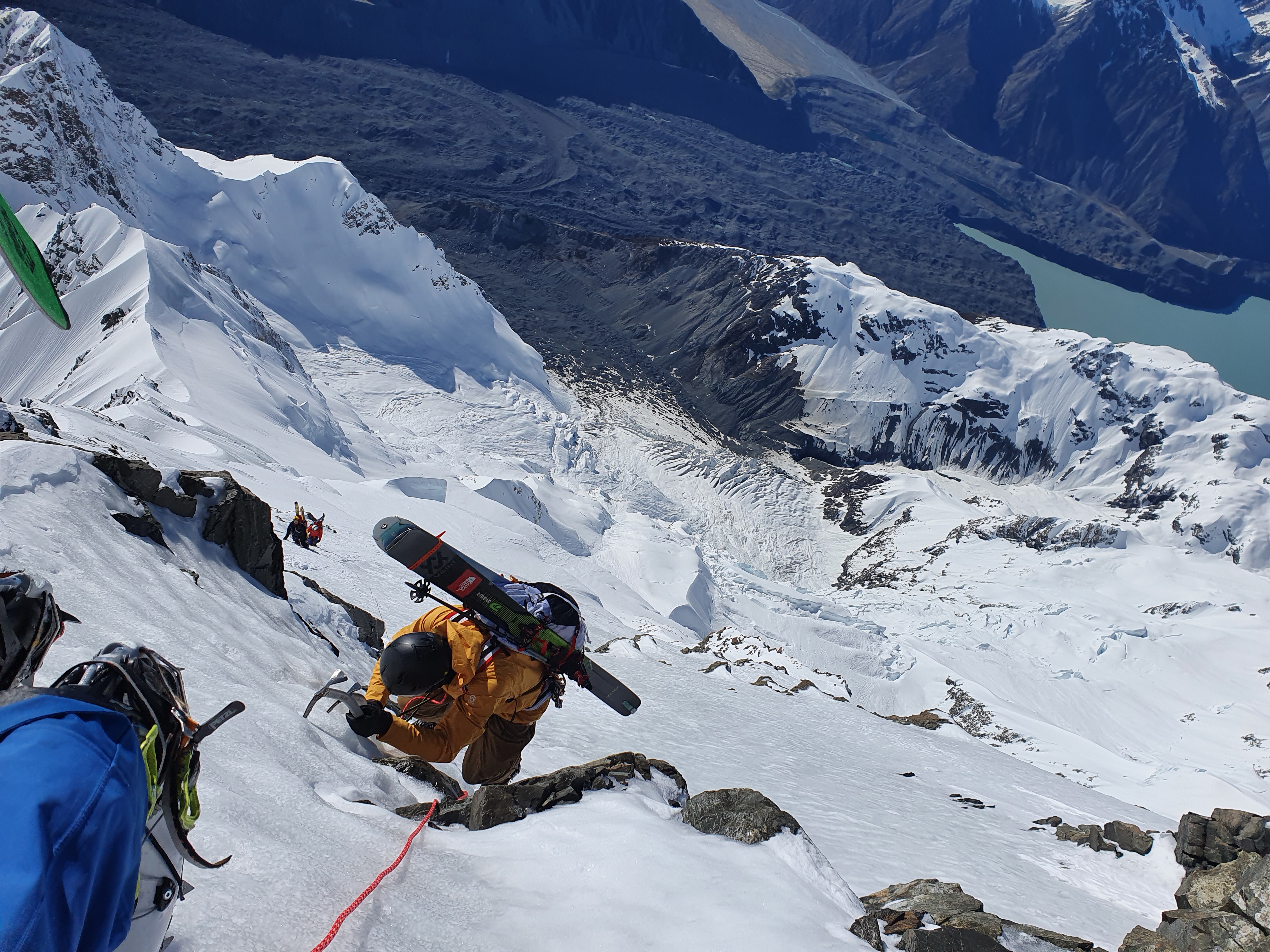
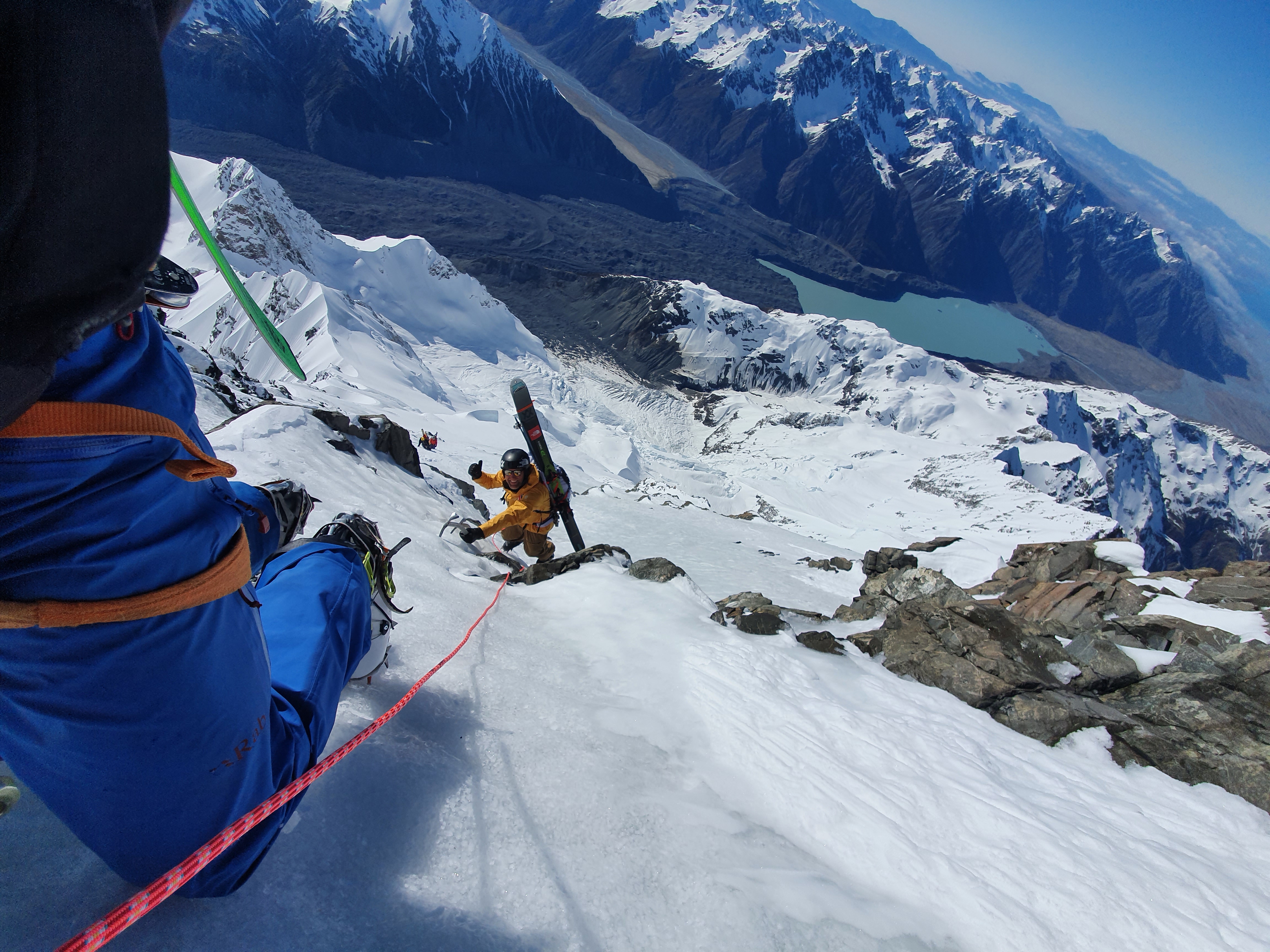
The line is in 2 distinct halves – above and below Queens Drive. Above is the climb – steep, narrow, and tight with several rock steps you have to either air or rap. The very top section from the ridge takes you diagnoally down and right to the main fall line, and the first rock step. Roughly 2-3m high into the steepest and narrowest part of the line, with only about 20m or so after to control your speed before the next cliff. I went off the skiiers left of the block where the drop was smaller but you land in a really narrow part of the gully. A more heroic option would be straight off the end of the block, but you really dont have long to stop before the next cliff, and falling through it would be seriously bad.
If you were going to rap this middle cliff a picket would be the way. Unusal to get good ice just there and scraping around for rock pro would be a pain.
The next cliff is a similar height, but had ice on the landing when I was there so I put the crampons on and downclimbed. But again I reckon it would go late season in a big snow year!
Once the skis are back on the pressure is off and its type 1 fun – blast down through Queens Drive and down the gully until the snow runs out! I then just hiked back up to Queens Drive and out to the ski field. I would definitely NOT recommend carrying on down the West Face – did this on a previous trip down Morning Glory and it turned into the quest of all quests
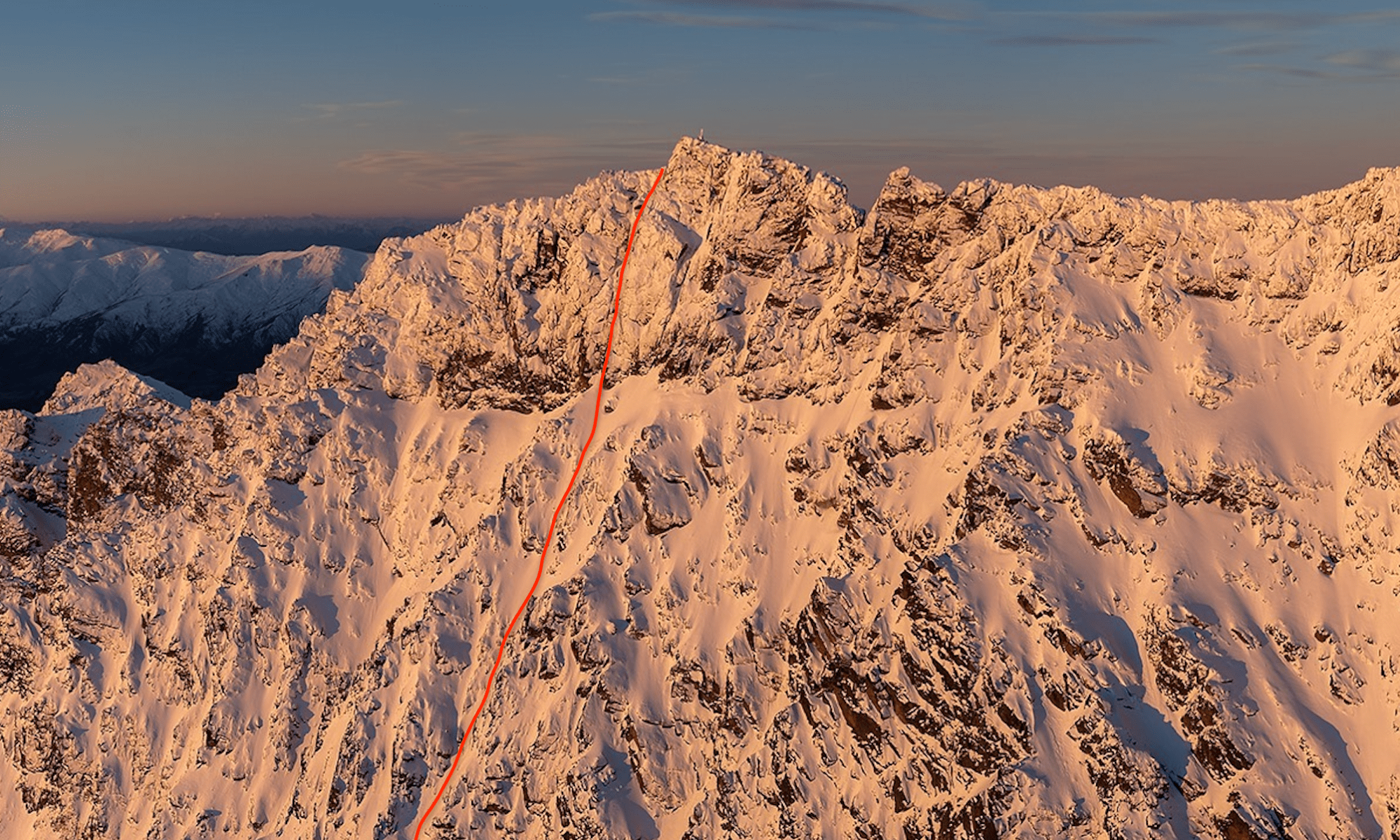
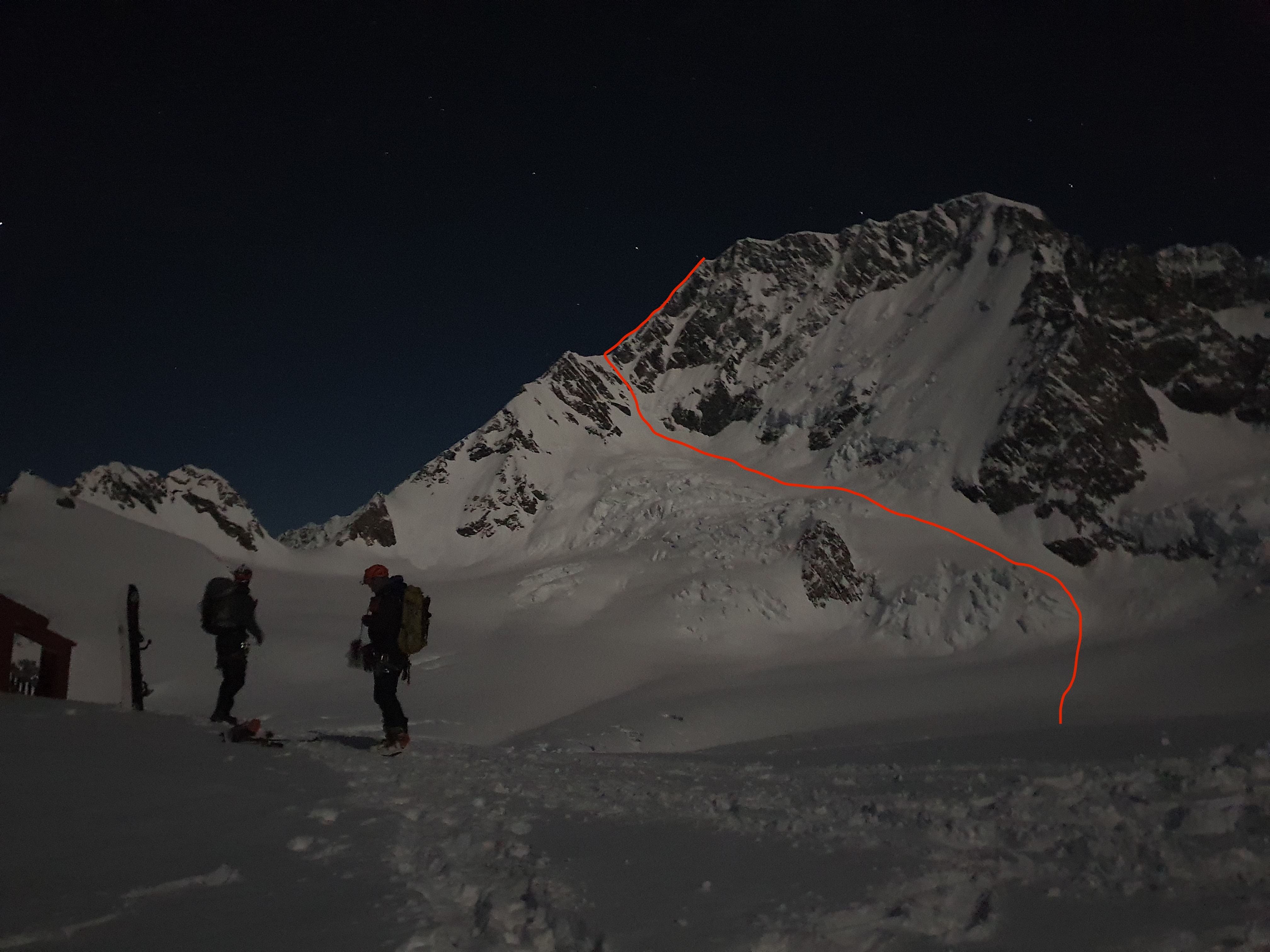
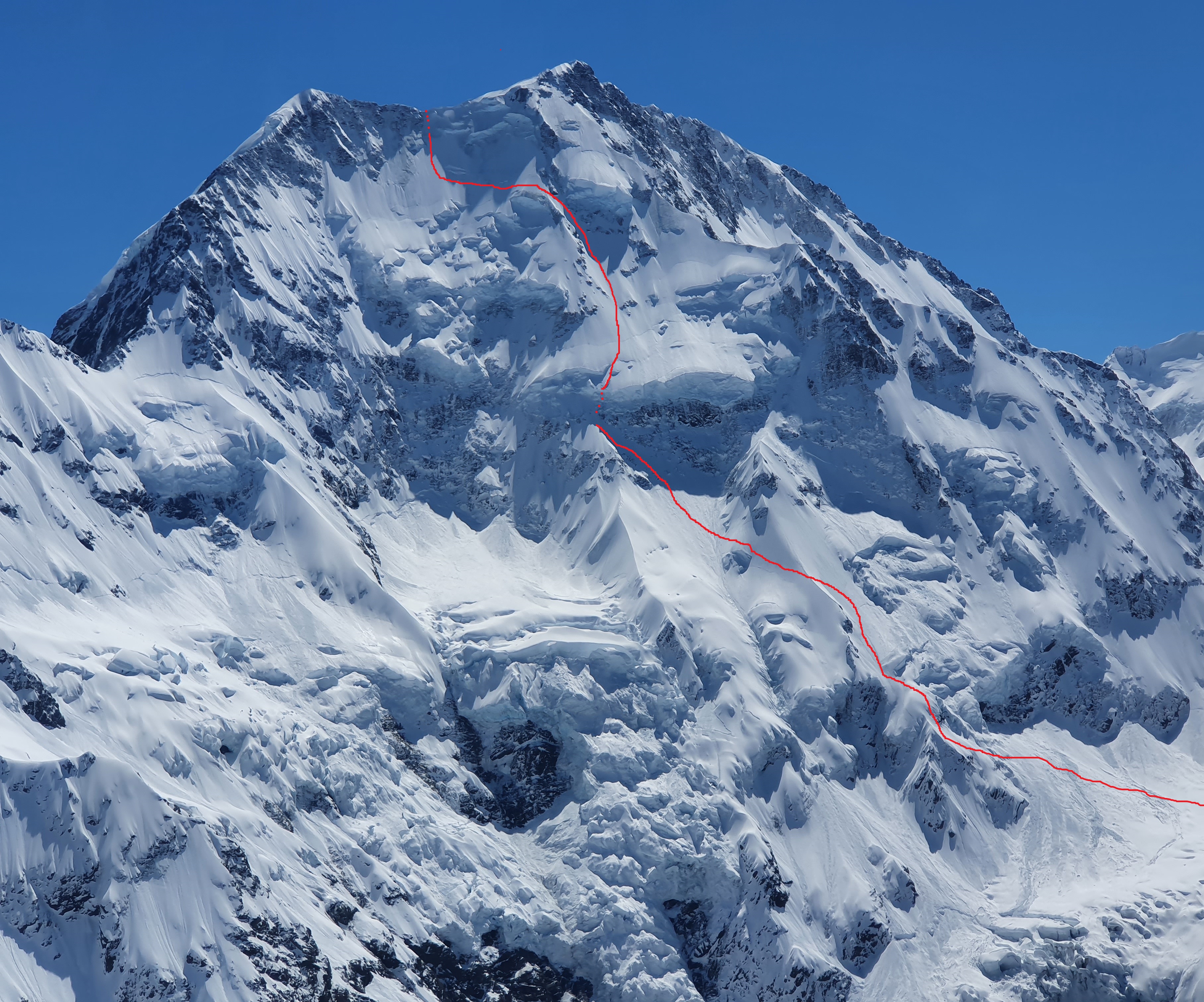
The big obvious ski line visible in the distance when looking south from Wye saddle, I’d been wanting to ski this peak for years before finally getting round to it. Beautiful north facing spring corn in a striking couloir from the highest peak in the range make this a very worthwhile outing. It makes a great day trip from Lake Hope, or a big mission with a very early start from the Remarkables. We skiied the line marked in the photo on the North East aspect. A slightly steeper couloir on the North face looks excellent, but had a bare rock step that would have required a rap when we were there
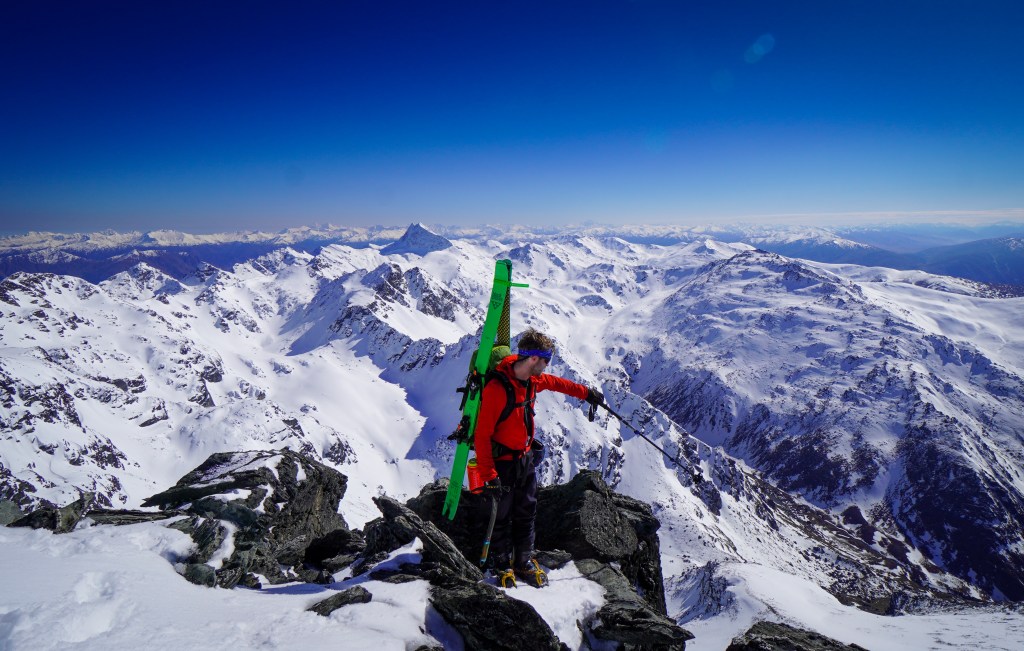
Alex on the summit, with double cone visible in the background
Length – 600m (300m main line, further 300m bowl to bottom of valley)
Steepness – 35 deg average. Steeper at the top before opening into a wide open 35 deg bowl
Exposure – Nil on descent.
Aspect – North East facing. Perfect for spring corn early in the day
Extras –
Difficulty – 3.2 E1
Equipment – Crampons, 2x tools (1x will be ok if your climbing the ski line and your confident on your crampons. Traversing from the West is a bit more involved and 2 tool was nice.) Snow stake, rap tat if your taking the central couloir as it may need a rap. Otherwise no rope needed.
Approach
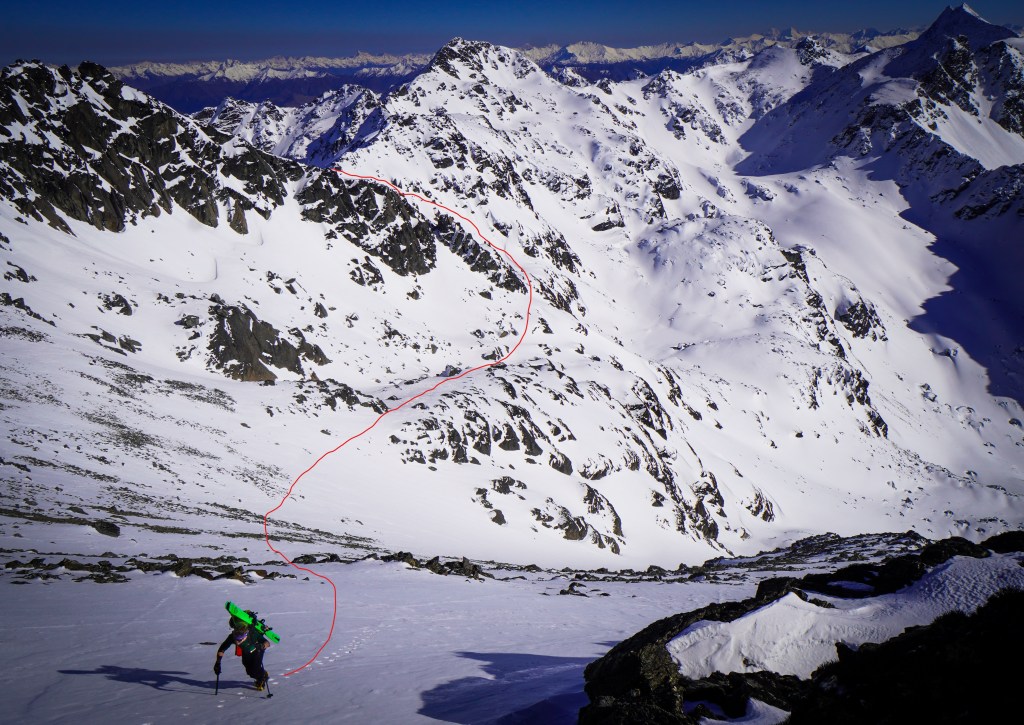
We did this as a day trip from Lake Hope, where we were camping for a few nights. This is the easiest access – its a quick skin from the lake up to the ridge East of 2080. Its then straighforward to gain the 2000m contour and climb up the gully from the West, traversing the peak and then gaining the coulor. It took us 3 hours from the camp site to the summit.
Climbing the NW face, the line we took from Lake Hope marked in red
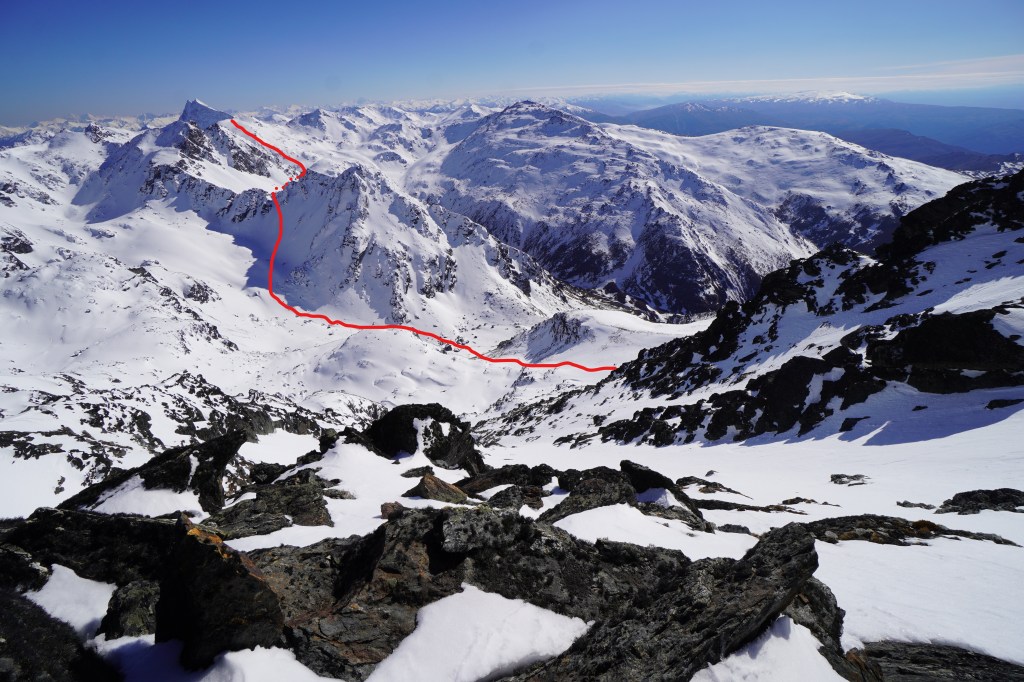
The alternative is to skin out from the Remarkables – I did this route on a seperate trip, and have attached the GPX file below. You can do this as a big day trip but you have to start very early. It took us about 4 hours from Remarks base building to the bottom of the face, and leave at least another 1.5 to 2 hours to climb the face. When we were there the corn was good to go 10:30-11 so you need to be at the summit around then. Skin to Wye saddle then point it down to the ridge west of point 2046 , then sidle up to the col between 2115 and 2122. The cruise down the the Doolans Left Branch and then head up to the small lake between 1964 and 2130. Climb the small headwall above the lake and then its a short ski down to the bottom of the face.
The approach from Remarkables ski area to the bottom of the ski line. Doolans creek left branch on the right of the photo. Point 1986 the peak in the middle of the pic (looks like a sick ski line!)
The climb is straightforward – even more so if you just climb the ski line. Just boost straight up the face and you shouldnt have any problems. Coming in from the Lake Hope side is slighlty more involved as you have to traverse across a couple of rock steps on the way to the summit. Once on the sumit its a short easy downclimb to the start of the skiing.
Traversing across from the NW face towards the summit
Ski Descent
A short downclimb from the summit puts you at the top of the snow field. From here you can blast down a 40 degree couloir for the first 500m or so, before the angle mellows to around 30 deg and it opens up into a wide open snowfield. From the 1700m countour we had to pick our way down a narrow strip of snow to the large flat area at 1500 where there was some much needed running water. If you time the corn right thiis is a super fun cruisy descent and you can really open it up and point it.
A short easy downclimb puts you onto the ski line, visible just to the right of Alex
From here, its easy to get back to Lake Hope – head up the river and round the back of 1911 then up the ridge to the col between 2087 and 2080. Be carefull as these slopes are also North facing so if youve timed the ski line right these slopes are going to be getting really soft. This ridge is pretty low angle and also when we were there you could actually stay on a rock rib almost the whole way and avoid the avvy risk completely.
The ski line. A shorter variation is posisble from the shoulder on the left, and a harder steeper one from the summit straight down the middle couloir. Check if the rock step is in or not – would have required a rap (or hero send) when we were there
Option 2 is to or start the long skin back to the Remarks. When we skinned it we took a slighlty different route back to the way we came in, which is visible on the GPX file. Same we loose risk applies as your crossing a bunch of north facing slopes late in the day. We started the same way over the col just west of 1964, but then went down north to the left branch. We then skinned basically up the river bed following the low angle slopes to the 2115/1967 col. We followed the ridge past 2020 and 2046 – this puts you on top of some super fun couloirs that drop from around 2017 down to upper Wye Creek. If you time it right these makes for a super fun short ski to end the day.
Doing this as a day trip from Remarks is a big old day – around 3000m of climbing and 25km distance. I’d expect the whole trip to be around 12 hours.
On the skin back to lake Hope. Taken from just above 1911 looking north. 2130 in the background (another fun looking south facing ski!)Standing at the flat area at 1500m looking back up at the line. The thin stip of snow we took down to the base in the middle of the shot.
The wild side of Aoraki! A long and serious approach with no heli access gives the Hooker a wild and remote feel. This was my first trip to Aoraki back in 2018 and it was definitely jumping in at the deep end. While not too much steeper than the East face the NW couloirs is winding, technical and exposed nature make it a much more serious undertaking, and as such it is sees far fewer descents. You’ll be rewarded with an incredible ski line and a feeling of isolation that is definitely missing on the Plateau side. We climbed to the top of the skiiable line and turned round, but some easy mixed climbing would take you to Low Peak a couple of hundred metres higher. You would then need to make a couple of raps to get back to the line.
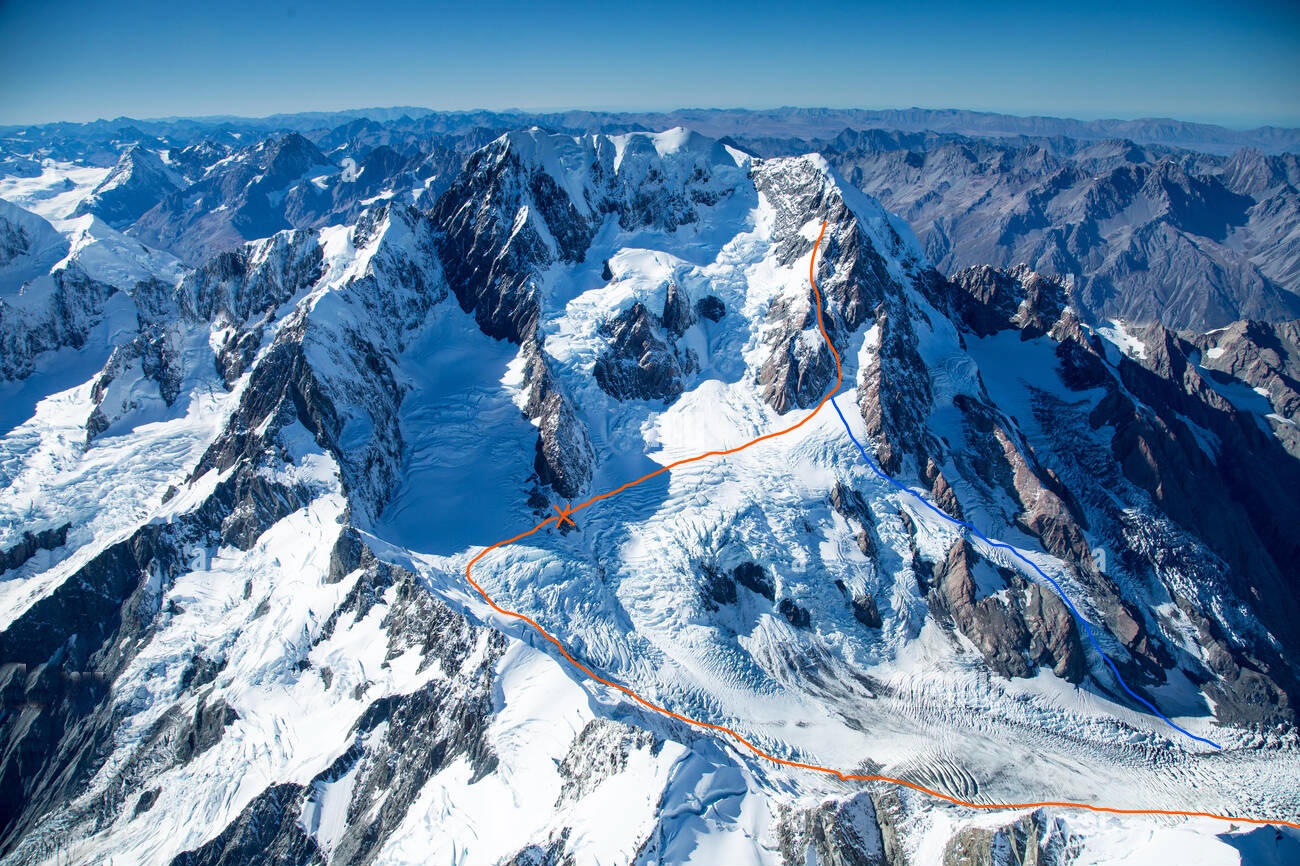
The line we skiied in red – we stopped at the rock just below the summit. Empress hut at the X. Alternate descent in blue from the base of the couloir to save you a trip back to the hut – wasnt in condition when we were there.
Length – From Empress Hut (2500m) to Low peak (3593m) is just over 1000m. Then around another 1700m down to the car park at 880m. When we were there the couloir was skiable from around 3300m
Steepness – Crux at the top of the couloir. 50-55 deg for 100-200m. Remainder of couloir 45 deg. Once on the Empress glacier eases to 35-40 deg
Exposure – Very exposed at the top, as the couloir winds over some big cliffs. Once you reach the Empress shelf this improves. Couloir prone to significant rock fall once it warms up, particularly late in the season. Very large crevasses and active ice cliffs on both sides of the Hooker.
Aspect – NW. Good corn skiing late season, but significant loose wet and rockfall risk late in the day
Extras – We needed to make 1x 15m rap right at the bottom of the couloir to cross a small rock band
Difficulty – Climb 3. Ski 5.3 E3
Equipment – Glacier equipment. 30m half rope. Tat and snow stake for raps. Screws x2 each and V thread equipment.
Approach
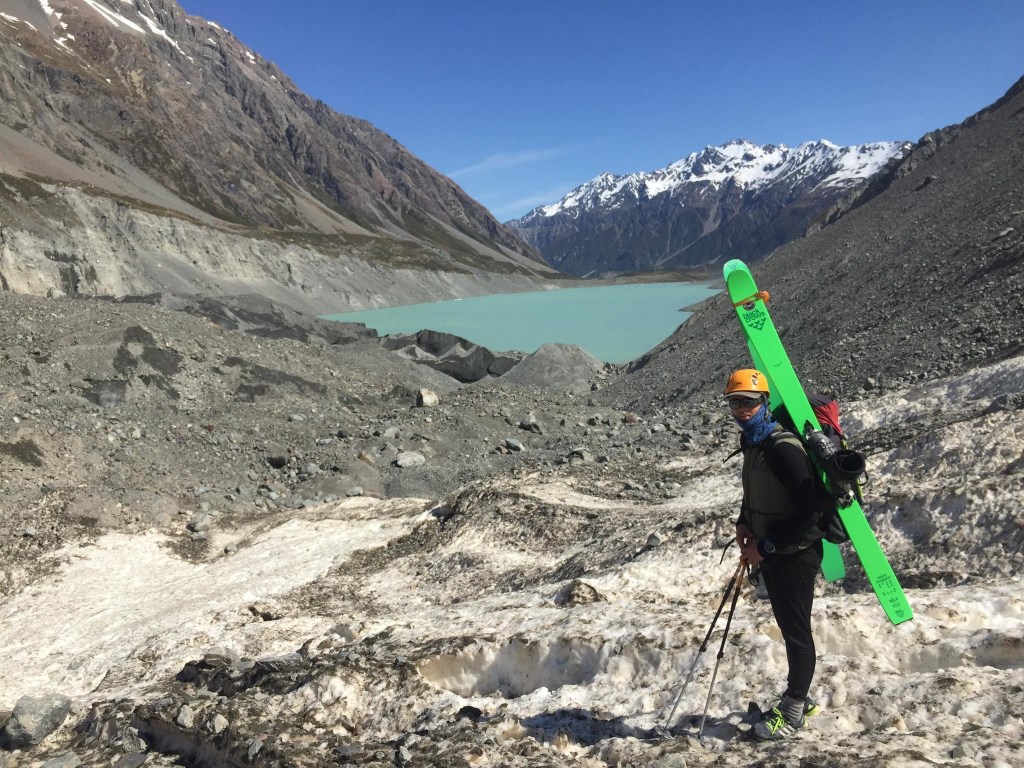
Looking back down towards the Hooker lake from the Hooker glacier
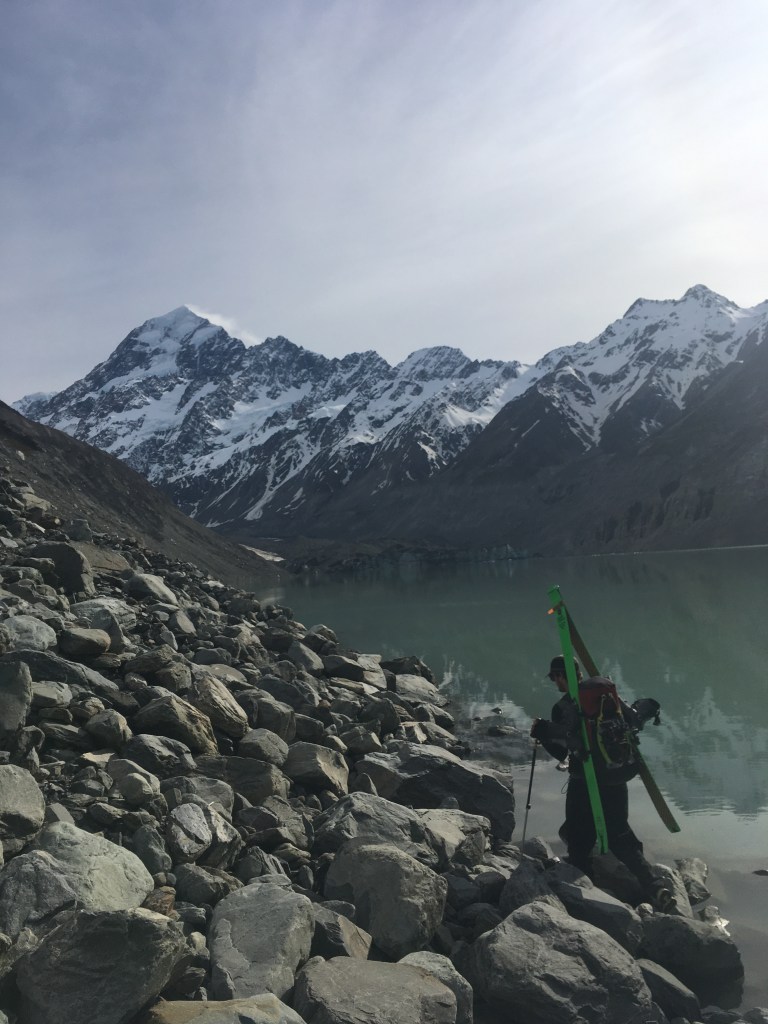
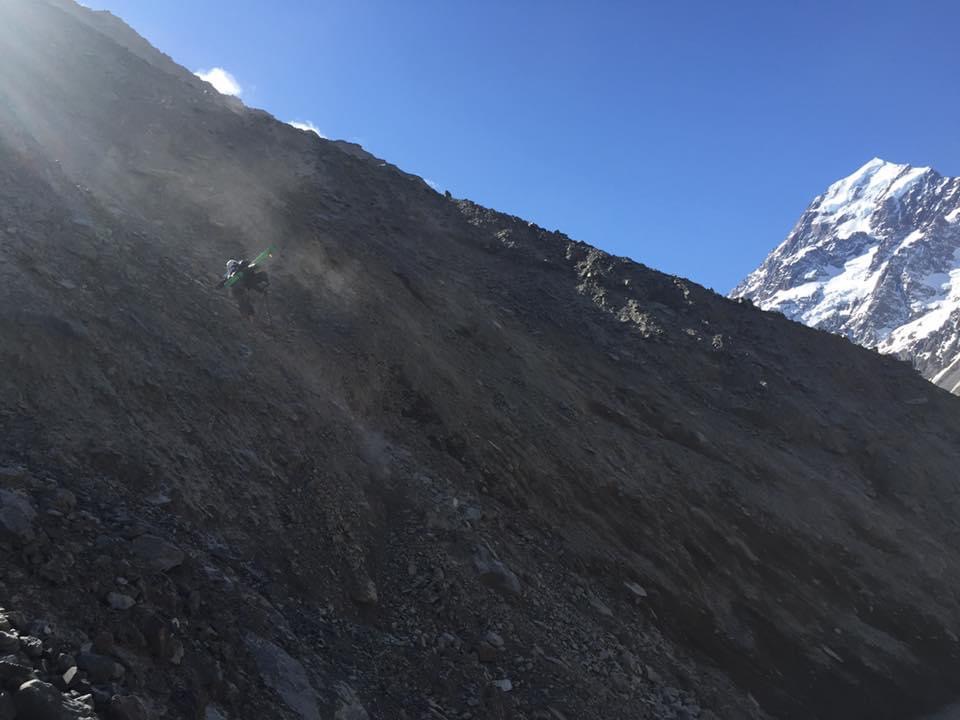
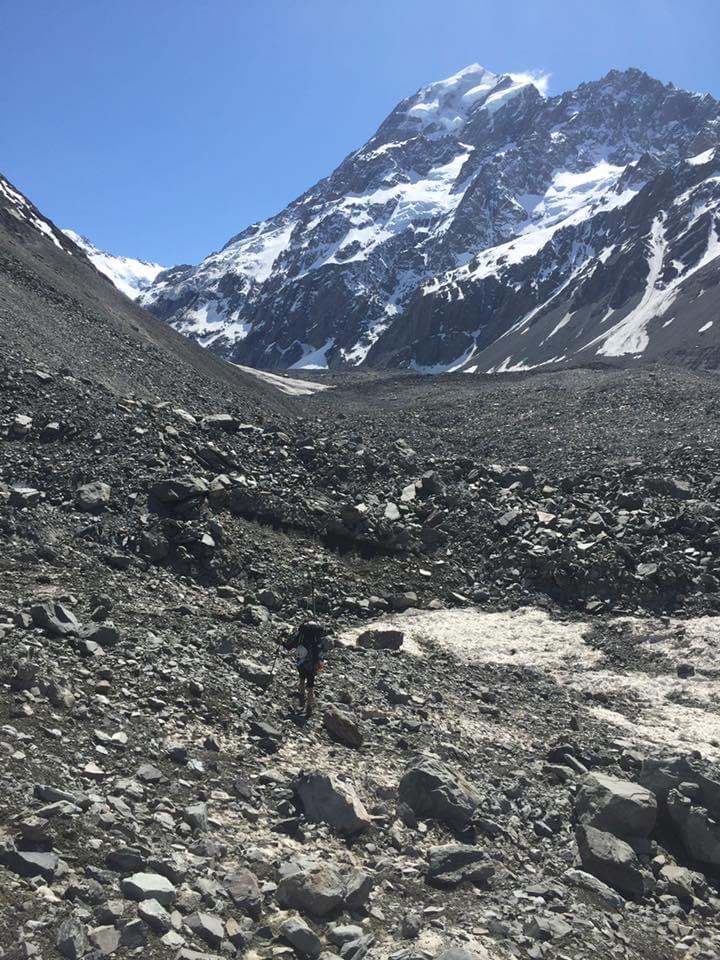
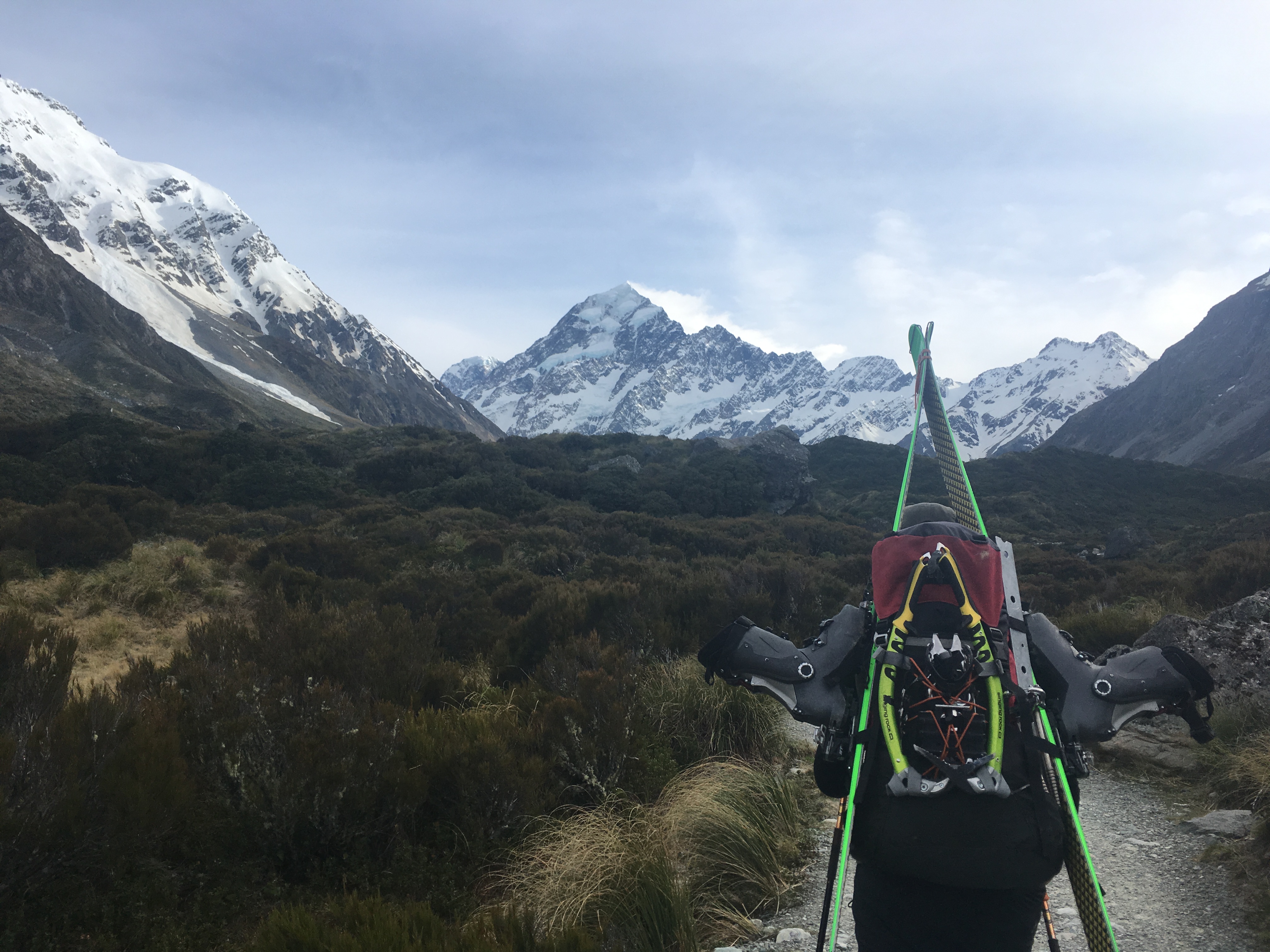
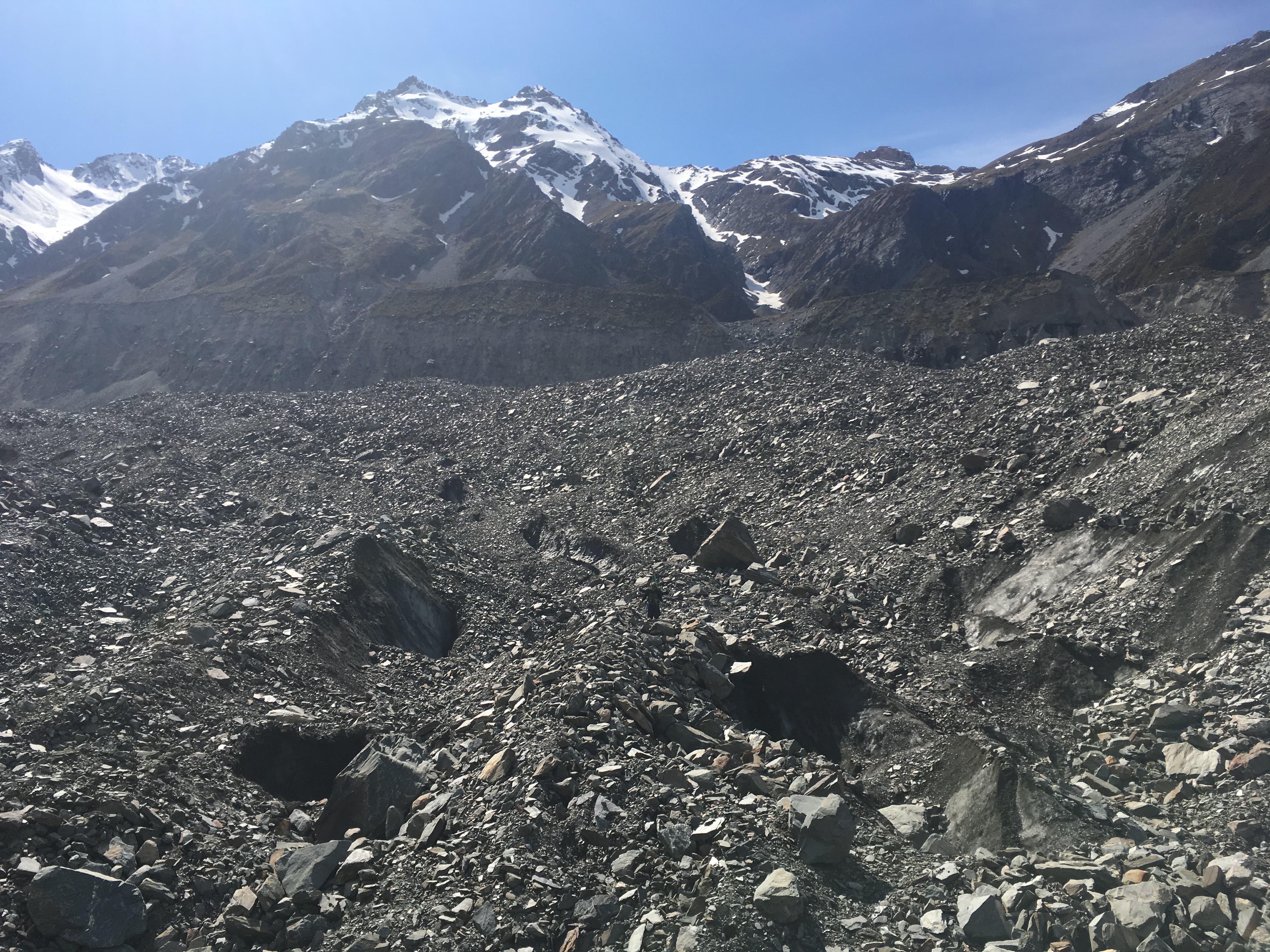
It took us just under 12 hours in total to get from the car to Empress hut. Head up the Hooker track to the Hooker lake. We then rock hopped at the shore line most of the way up the west side of the lake. Just before after Stewart stream the moraine got too steep due to a washout and we had to climb vertically up the moraine wall to around 1200m before traversing along flatter ground and then dropping back down to the main Hooker glacier. This section was really difficult especially with heavy packs. The morraine was incredibly loose and you constantly had to be looking above you for spontaneous rockfall coming down to the lake. Taking a step into the loose morraine would cause everything to shift and would cause rocks 30m above you to start moving and coming down. It would also be easy to slip and fall all the way down into the lake which would be suboptimal while strapped into a heavy pack. Overall we felt this was the most dangerous part of the trip and we were super stoked when it was over.
Easy rock hopping up the side of the Hooker lake, before the moraine walls got steep and sketchy
Towards the top of the lake you get into this terrain – steep and loose moraine wall which is pretty sketchy. Stay a long way away from you partner and the inevitable stream of rocks they knock down
Much easier ground on the flat moraine between the lake and the Hooker glacier. South face of Mt Cook ahead
From the top of the lake we headed north staying pretty much in the middle of the glacier until we reached snow. This was the same loose moraine but on flatter ground. Tiring but safe. After a few hours of this it was a relief to be finally able to put the skis and boots on and start skinning.
The way you pass the lower ice fall on the Hooker is very condition dependent. When we were there the true left (Pudding Rock) was completely cut off and so the only option was the true right. We were tucked right into the far west of the glacier and skinned up under Dilema peak, the end of the Straunchon glacier and finally under La Perouse. Everything was very open here and we were picking our way through the crevasses over winding and narrow snow bridges (check out the end of the video below to get an idea). Complex route finding but relatively safe as what you see is what you get. From around the 2000m contour things open up and we were back to skinning straight up the glacier for the remainder to the hut.
Looking up the Hooker. The way you get past the major icefall will depend on the state of the glacier. We stuck to the far left of the picture but when its more filled in you can stick to the far right (Pudding rock)
The crevasses here are humongous – we would regularly cross 20cm wide cracks in the snow, and only when directly on top of the crack get to look straight down to see that in fact we were on a snowbridge spanning a gaping monster that disappeared down into the depths of the earth. Several times the 10m of rope between us was barely enough to keep us from both being on the same bridge at the same time. In addition the ice cliff on the east of the glacier at 2200m (just below the words Empress Glacier on the map) was highly active, regularly throwing off car sized chunks. We were thankfully able to stay far enough west to be out of the firing line. However the east faces of Dilemma and La Perouse had regular rockfall once the morning sun started warming them up and there was no way to stay clear of both and get through the crevasse maze, so we had to move fast and keep our fingers crossed.
Skinning up through the maze of crevasses on the Hooker icefall
All in all this was a pretty hectic experience and I got to the hut feeling like I never wanted to come up the Hooker again. From speaking to friends who have been up to Empress I think it was especially scary when we were there and this isn’t a typical experience – later in the year and everything would be more open with no hidden surprises, earlier everything would be more filled in. Either way it put me firmly into the ’we should open the Hooker to heli access’ camp, especially as the whole way in we could hear the buzz of scenic flights overhead in anycase. Maybe not a popular opinion with the purists, but Im sure would increase the number of people who would enjoy the epic terrain above the Empress hut.
View out from Empress hut, La Perouse on the right
Empress Hut is a pretty special place – the difficult access means it not many people make it up there and so you can flick through decades of entries in the hut book and soak up the history of the area.
Empress hut
Climb
Will booting up the lower section of the couloir. This part is wide and straight and is the easiest skiing meaning yo ucan open it up a bit
Pretty straightforward when the conditions are good. We had a good overnight freeze and so fast efficient cramponing conditions. We skinned (ski crampons were essential) south from the hut to the base of the couloir just south of the NW ridge. From here we transitioned to crampons and booted up the route. We used the rope to cross the shrund at the base but otherwise we soloed the whole way making fast progress. The couloir fans out into a couple of possible exits at the top – if you continue directly up fall line it turns into some M2 mixed climbing up to the West ridge and Low Peak. We wanted to just maximise the amount of skiing and so didnt bring equipment for mixed climbing or raps, and headed to climbers left up a narrow couloir onto an open snow fan at around 3300m. Another option from here would be traversing north to Porter Col if you wanted the summit without any mixed climbing. For us that would have been bare ice on this section, so once the snow ran out we transitioned to skis. This was a technical transition, on very steep exposed and firm snow, and any equipment (or people) dropped at this point would end up on the Empress shelf 1000m below. We protected it with a snow stake belay.
It took us around 3 hours from the hut to climb the route. We had perfect conditions and soloed the whole route so it may take longer than this
Ski Descent
We started skiing at 9am. This was too early and the snow was still pretty firm, which given the exposure made things pretty spicy. We had to be back in the village that evening though and didnt want to be coming back down over those snowbridges too late in the day. Time to put the edges through their paces!
Joe making turns on the lower part of the couloir
The initial snow fan was a touch under 50 degrees, and wide and open (but with serious exposure to the right). Once we hit the couloir the steepness ramped up to over 50 deg, and initially only just wider than a ski length. Cue cautious high pressure jump turns. This steep technical skiing lasted around 100-200m before the couloir gets much wider and the angle eases slightly and we opened it up a little bit more. Your still pretty exposed in this section as there is a dog leg and small cliff right at the bottom of the couloir to negotiate.
Will coming out through the crux, the choke at the top of the couloir.
Right at the bottom we made a 15m rap to get through the dog bone, putting us just above the shrund. There was a good spike to leave tat around for the rap. From here we just had to make the obligatory shrund send to get into the sun and beautiful corn on mellow 35 degree slopes. Sometimes a route might go from here south crossing the Noeline Glacier to drop you at the bottom of the Hooker (passing just to the left of the W of West ridge on the map) but we had scoped this on the way in and it was a no go. So we skiied back to the hut, grabbed the rest of our kit and headed down the same way we came.
The dog bone at the bottom of the route. We made a short rap here
We blasted it down the top section of the glacier until reaching the ice fall under Baker saddle. Given how open this section is we decided to ski down through it while roped together. This is pretty difficult and theres a real risk of it causing more harm than good – if you dont have perfect timing and very clear communication as you cross the gaps you risk just pinging your partner off balance and throwing them into the crevasse. We had our system dialled and were moving slowly carefully and precisely through the crevasses – until a rock fall released from the Baker Saddle area 200m directly above us. Caution had to go out the window and we started straight lining it through the maze of narrow snowbridges to a safe spot out of the firing line. Probably one of the scarier experiences Ive had in the mountains!
Picking our way through the lower ice fall
Once through this it was a case of reversing the Moraine slog. It was pretty scorching by this point, but there are a couple of hidden water sources on the morraine to get us through. We made it back down in time for a feed and post mission beer in Twizel before hitting the road back to Chch
Don’t be put off by the fact this line is on the Caroline – it has none of the objective danger, super easy route finding and a quick easy climb to get to the start of the line from Plateau. Probably the best bang for buck ski line I’ve skied in NZ, deserves to be more popular! We spotted this line while skinning back up to Cinerama col after skiing the Caroline and thought it looked epic, so booted back up the next day with Will Rowntree, George Millets and Clem Cadario.
Length – 800m Steepness – 45 deg Exposure – Above some cliffs initially but once your on the main body of the line its a straight line down to the Caroline glacier. You are exposed to some overhead hazard on the approach under the East face but you can skin quickly through this section Aspect – SE Extras – nil Difficulty – Climb 2. Ski 5.1 E2 Equipment – Glacier equipment.
Climb
The icefall on the right of the photo is very active so move fast! We skinned all the way to the base of the ridge, then bootpacked up from there
From Plateau, it’s really quick and easy to get to the start of the line. Ski across the plateau towards the base of the East face and skin up and along the shelf under the East face to the East ridge. The ice falls at the base of Zubriggens and the East face are active so don’t hang around. From here boot up the snow ramp, staying on the spine until you reach the ridge. There is a large obvious rock band that splits the E ridge in two, just to the right of our line above. This puts you at our start point marked with the red arrow on the pic below. Harder and easier variations are possible. For a harder variation, you could climb up to the right of the big cliff, as if you were headed up to ski the full Caroline. This would put you on top of the yellow line – a steep and technical looking couloir which the joins up to the normal line. As of writing hasn’t yet been skied! An easier option is to climb up even further left of our line putting you right at the edge of the E ridge. This would miss the first section of the descent which involves some skiing above exposure and puts you straight onto the fall line section.
Red arrow is where we dropped in. Other options would be staying further left on the way up with a mellower line starting to the right of the big rock right of the red arrow, or on the climb staying right of the big cliff band putting you at the top of the yellow line, which is a steep technical couloir
Take a look on the flight in at which route will go best. When we were there the line in yellow was looking a bit thin with some patches of ice and rock to negotiate, and after the previous days antics on the Caroline / post celebration goon head we were wanting something a bit more chilled. We left the hut at 0600 and were dropping in at 08:30.
The spine up to the ridge.
Ski
Will sending it down the top section, cutting left from the red arrow. It look narrow in the top pic but you can see here its actually super wide
Really incredible skiing. We had perfect shin deep cold powder the whole 800m down the line, and we opened it up cutting big fast turns getting face shots from top to bottom! From our starting point there was an initial super fun spine which was holding great snow. You are over some exposure on this top section. From there, we cut left between two rock bands to get onto the fall line section down that takes you down to the glacier. From here its consistent 40-45 degree skiing, with a selection of small spines and plenty of good safe spots to wait for each other. The angle steepens up a little for the final pitch down to the bottom and the shrund send.
Clem with the Tasman in the background
Routefinding is easy and by staying high on the face you avoid all the ice cliffs and objective serac hazard. The spot you get to on the Caroline glacier is above the large crevasses so the skin back up to Cinerama col is cruisy and straightforward
It took us around 45 min to ski the line and another half hour skin back up to Cinerama col, and we were back at the hut by 11:30. Clem and George then nipped up Mt Dixon and speed flew back down to land at Plateau in time for an afternoon heli pickup – pretty heroic stuff.
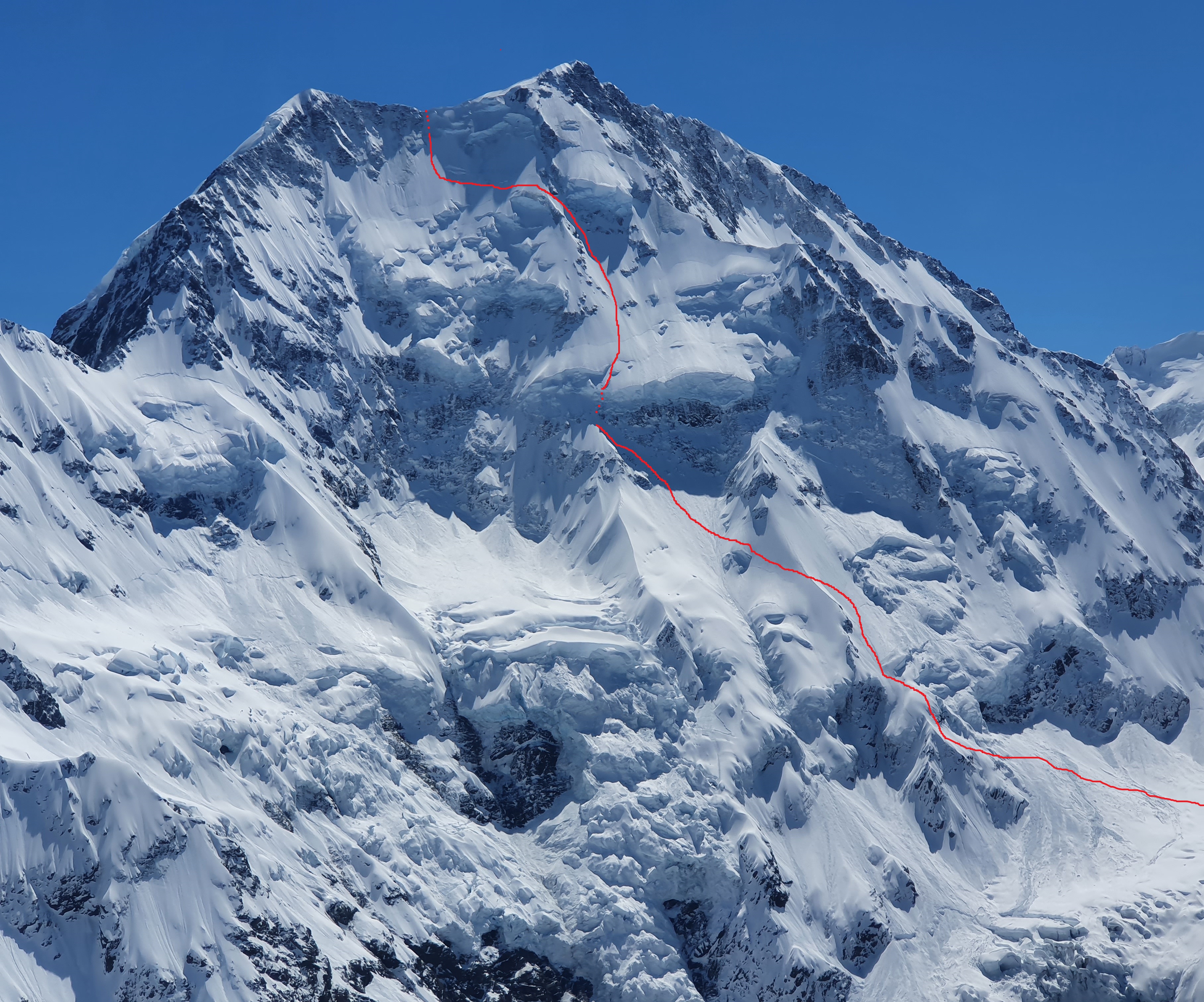
An iconic line in New Zealand mountaineering history – described as ‘the last great problem of New Zealand mountaineering’ when first climbed, it took another 40 years for its first ski descent in 2017.
This 2000m monster of a face is not to be undertaken lightly. Fickle conditions, complex route finding, objective hazard and sustained 45-50 degree skiing above serious exposure combined with a serious mountaineering route just to get to the starting gates, means you need to bring your A game for this line. For the majority of the line, a fall is likely to be fatal.
It took several years of planning, preparation and patient waiting for myself, Will and Sam to get the second descent in 2021. Without a doubt one of the most incredible lines I have ever skied, and the euphoric feeling stayed with me for a long time afterwards. But I don’t think I would ever skin the line again; the objective hazard from the constant serac threat is on the wrong side of that line separating acceptable and unacceptable risk. Even moving as fast and efficiently as possible, 2 hours spent under those ice cliffs is a roll of the dice and balancing the reward against that risk is a very personal decision.
Conditions
Really this is the crux of the route, and can be broken down into the condition of the ice cliffs and the condition of the snow.
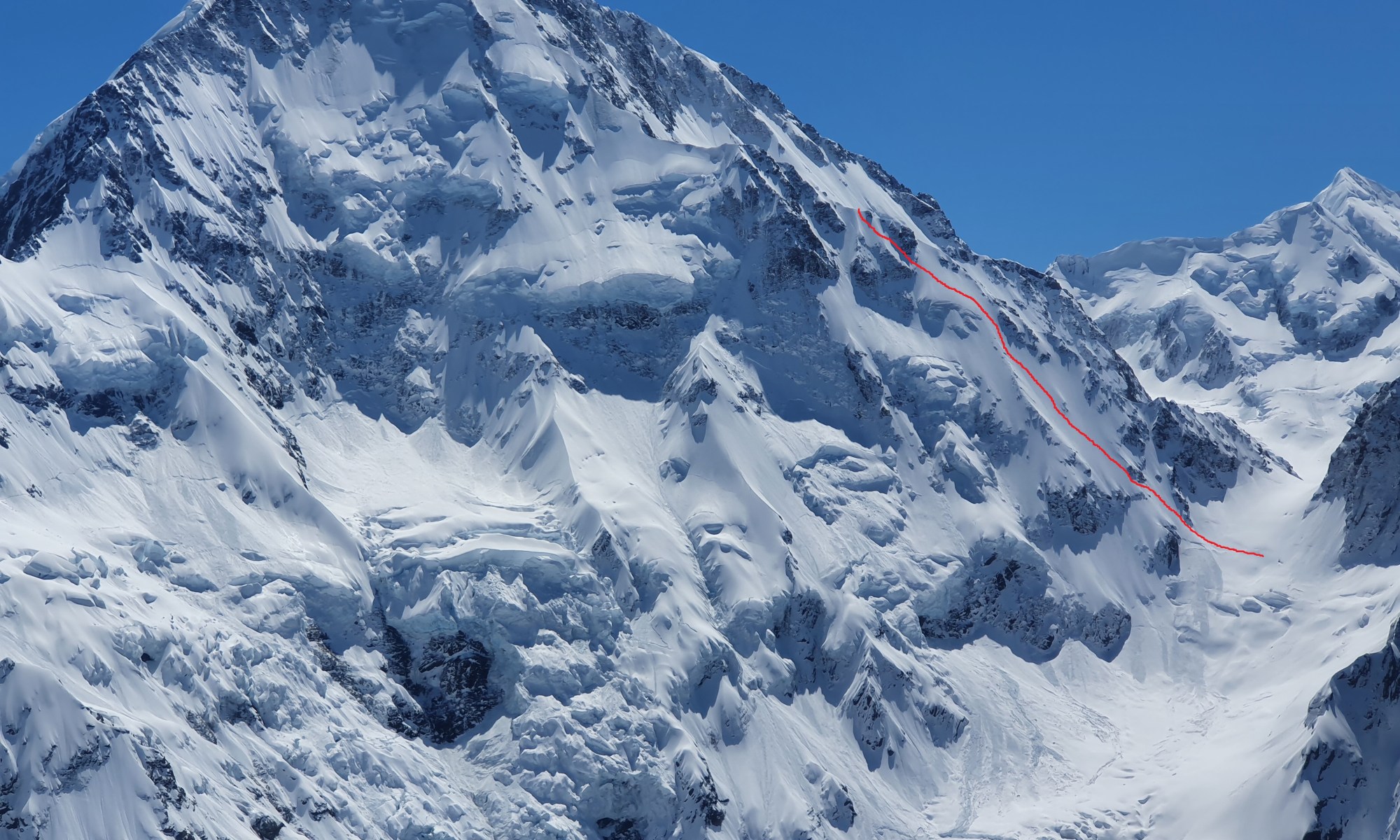
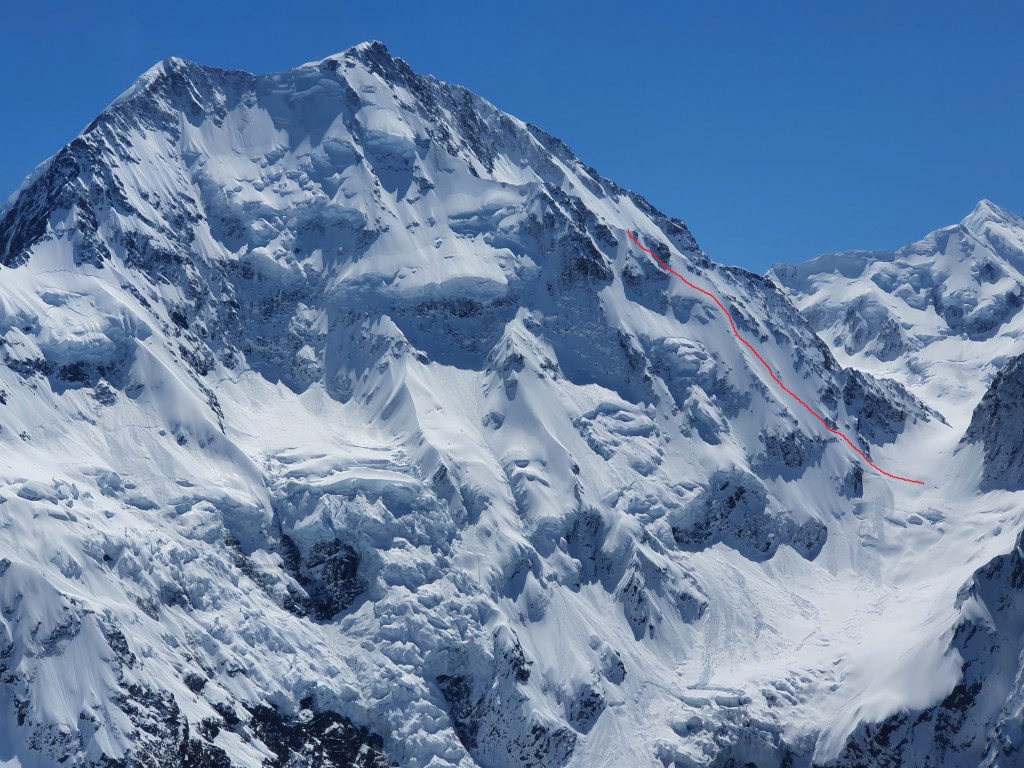
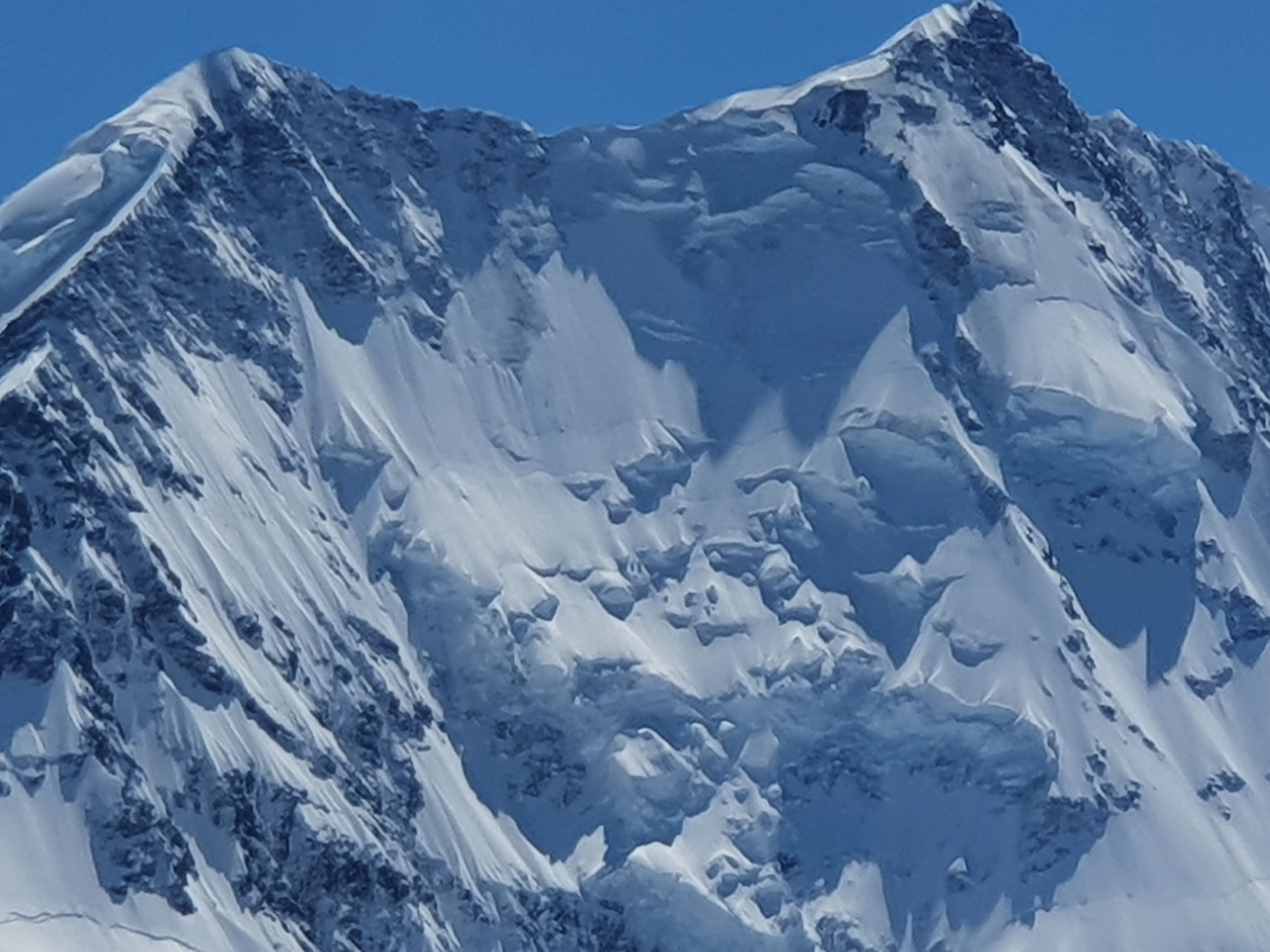
Ice cliffs – the state of the face changes significantly year on year, and also throughout the year. While the basic line that Ben Briggs and co took in 2017 is the same as our line, we crossed the 2 main serac bands in different places, and the next descent is likely to cross somewhere else again. Regularly following the state of the face through the year is key, and thankfully climbers and skiers are constantly flying past the face generating a beta stream. Once it looks like it’s in, the pilots will give you a really good fly by on the way to plateau. Multiple photos from multiple angles is crucial to get the line dialled, choose rap spots and make an assessment of coverage. We spent an hour or so zooming in on different spots on the face trying to find tell tale grey / blue shine that might suggest bare ice.
Snow – we wanted to ski the face in powder. Corn is the other option, but your time window between the top section softening, which is steep and super exposed, and the bottom section becoming dangerous is going to be pretty narrow given the complexity and length of the route. The biggest concerns here are avalanche risk, and hitting a section of hidden ice just beneath the surface which would knock you off your feet and you’d be gone. For a line like this I would normally climb the ski line and get a good look at conditions and identify any ice patches on the way up. Given the serac threat this isn’t an option of the Caroline so you have to ski the line top down, and back yourself that you’ve assessed correctly and can deal with the conditions you encounter. Our approach was to wait until late spring and generally stable conditions, and then wait for a system that was going to bring in warm precip turning cold during the storm, hopefully providing well bonded right way up snow sticking to the underlying ice. We wanted at least 24-36 hours of cold still weather for settlement and then another day of the same to ski the line. This is not common in New Zealand but in November 2021 everything seemed to be lining up so we flew in to take a look.
Approach
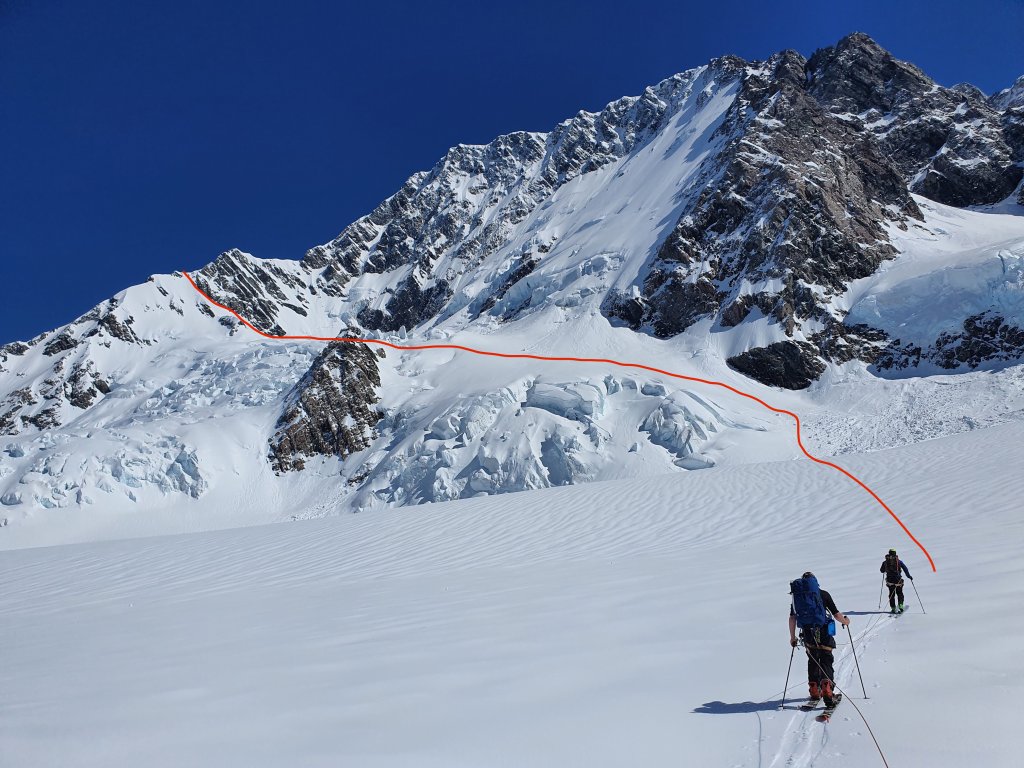
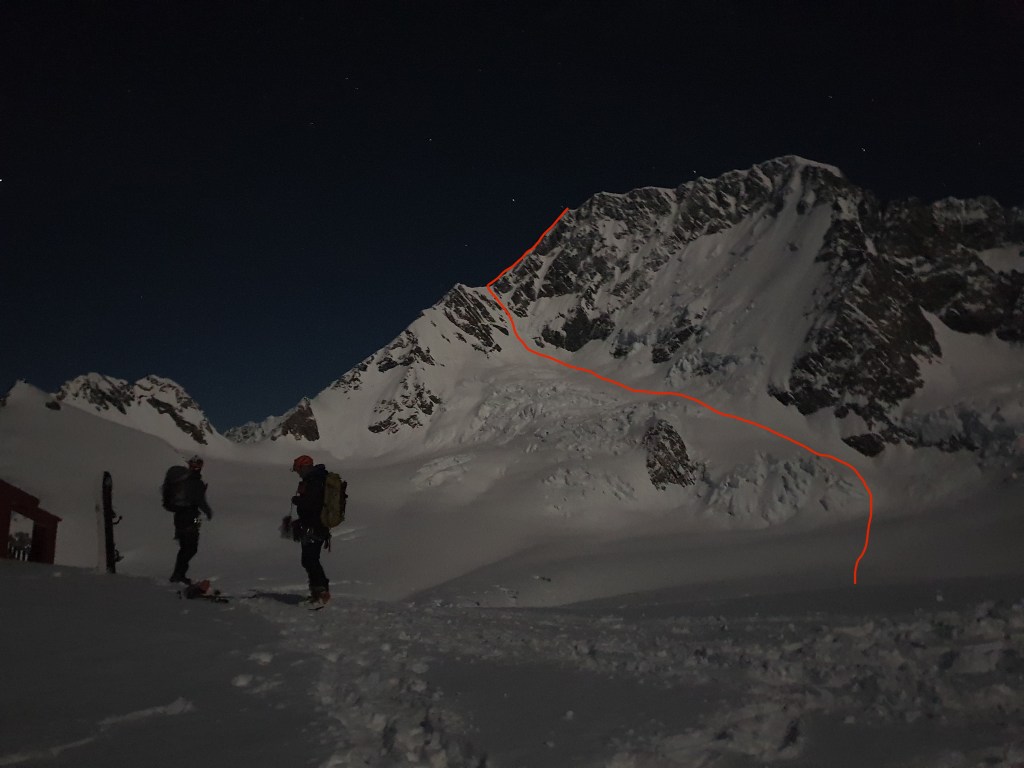
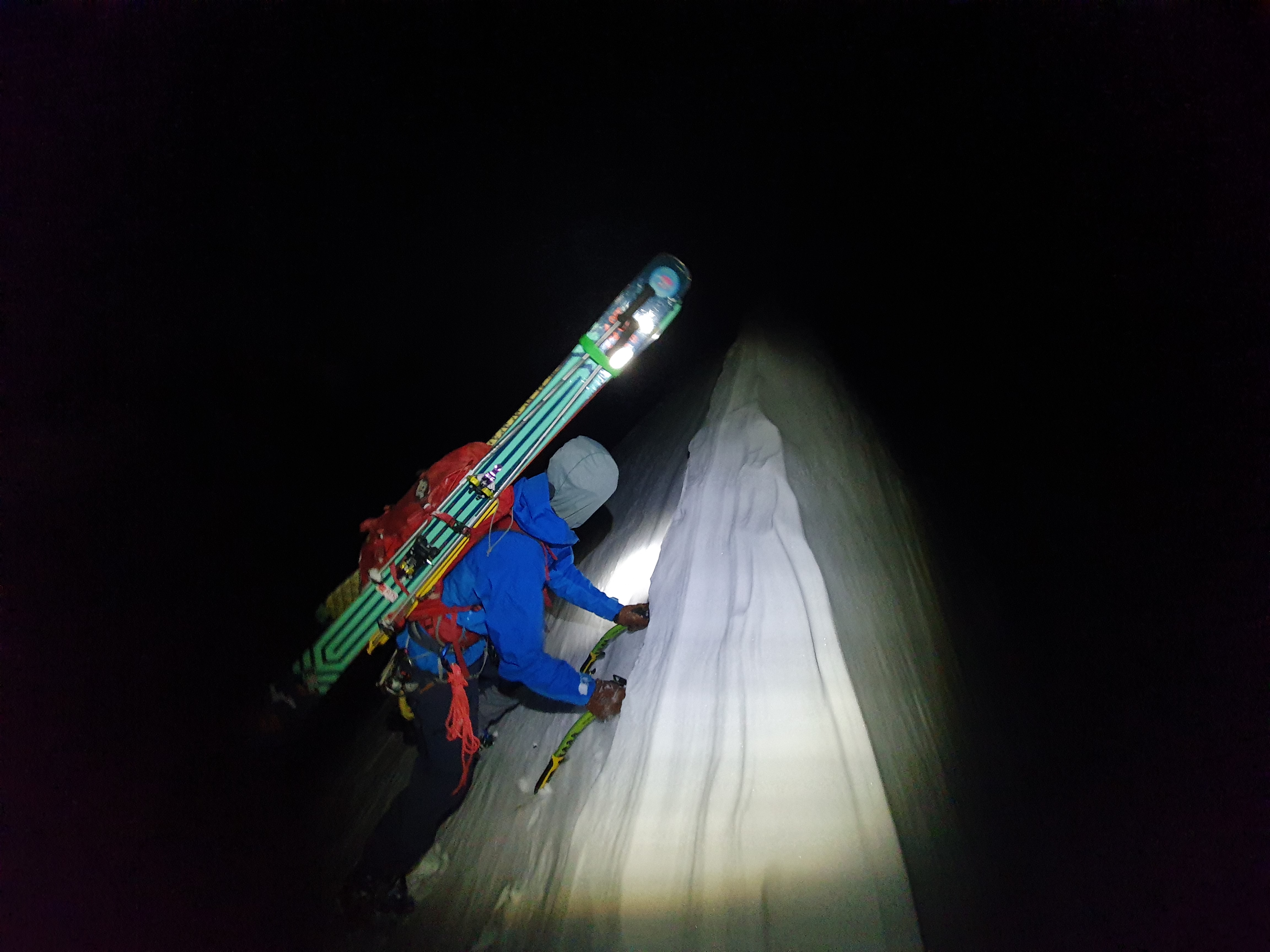
Plateau hut is incredible – the majority of New Zealand 3000m peaks within a 30 minute skin. The best approach to the Caroline is to head towards the East face and traverse high, climbing the snow gullies to reach the East ridge. This means you miss the first 400m or so of the East ridge, significantly speeding the climb. Once on the ridge, the soft confidence inspiring snow meant we made pretty fast progress by soloing the majority of the route. It also gives the opportunity to sidle onto the Caroline and assess the stability for the first time.
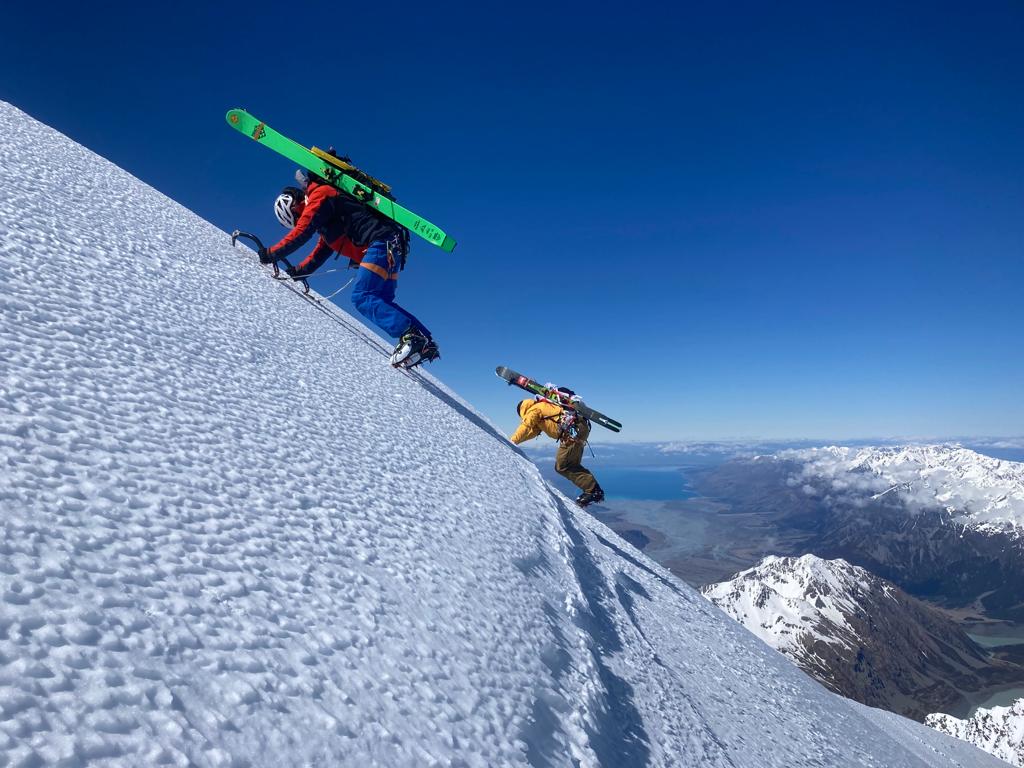
With everything looking good we continued up the East ridge. Once we hit the last couple of hundred metres it turned from soft to bare glacier ice so we put in 4 pitches up to middle peak. The climbing was super fun, easy WI2 , mostly 50ish degree ice with short steps up to WI3 over outrageous exposure. Halfway up the climb we saw a massive 500m wide avalanche rip down the face to our left reaching all the way down to the Ball Glacier. From the ridge you don’t get a full view of the face and it was impossible to see exactly where this had started – if it was on our line then either it was a slab avalanche and we had totally misjudged the avalanche risk, or if a serac collapse (the most likely thing) it would have cleared all the snow off the line leaving bare ice. Either way not good. We decided to carry on to the top of the east ridge and asses and discuss – if we were not happy then the bail out options from there would be the Grand Traverse and down the Linda, or down the NW couloir to Empress.
From the top of the East ridge, Porter Col is just a short distance South West. We took particular care here – the ice was totally bulletproof and a slip would mean a fall all the way down to the Empress Shelf. This was the spot that Magnus Kastengren tragically died in 2013 attempting this line, and that thought was in the forefront of our minds while crossing this section. From Porter Col for the first time we got a full view of the top section of the line – it was clear the avalanche we had witnessed earlier had come from serac collapse on the far lookers left side of the face, and had not affected any part of our line. The snow looked incredible from the top and after a long final discussion we decided to rap in and commit to the line.
The Line
Routefinding is key – have photos of the face on standby on your phone to reference, and have a mental image of the major landmarks on the face. Climbing back up under those seracs is not a position you want to be in!
Rap entry – I can’t imagine there would ever be a time when this top section would be skiable. A stretch of blue ice just below the ridge where it has been blasted by high winds, leading to the snow. We rapped around 80m in 2 raps, leaving a snow steak on the summit and a V thread half way down.
This is fairly committing – be ready for some WI4 ice to reverse this if the snow isn’t what you expected when getting to the face. Once at the snow we built another anchor for another stability assessment – while everything looked perfect we decided the first person down would ski 50m on the rope as a final assessment. Will took one for the team and dropped in first – a test of belaying skill to let slack out fast enough! With everything looking primo the rope went away and it was on.
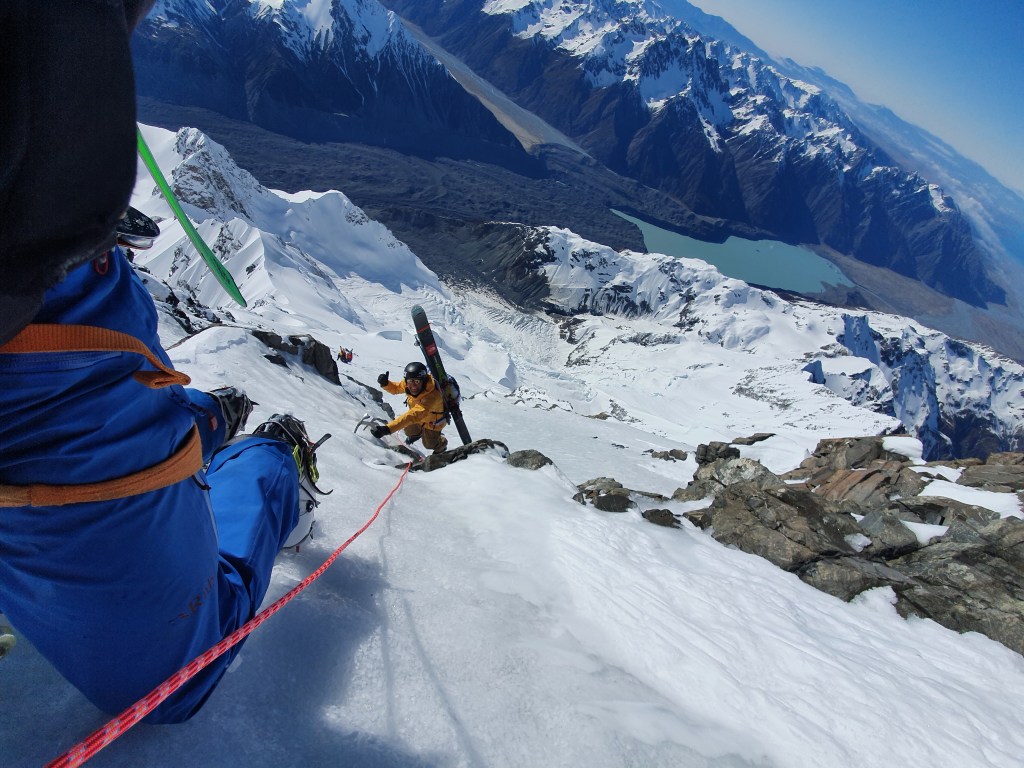
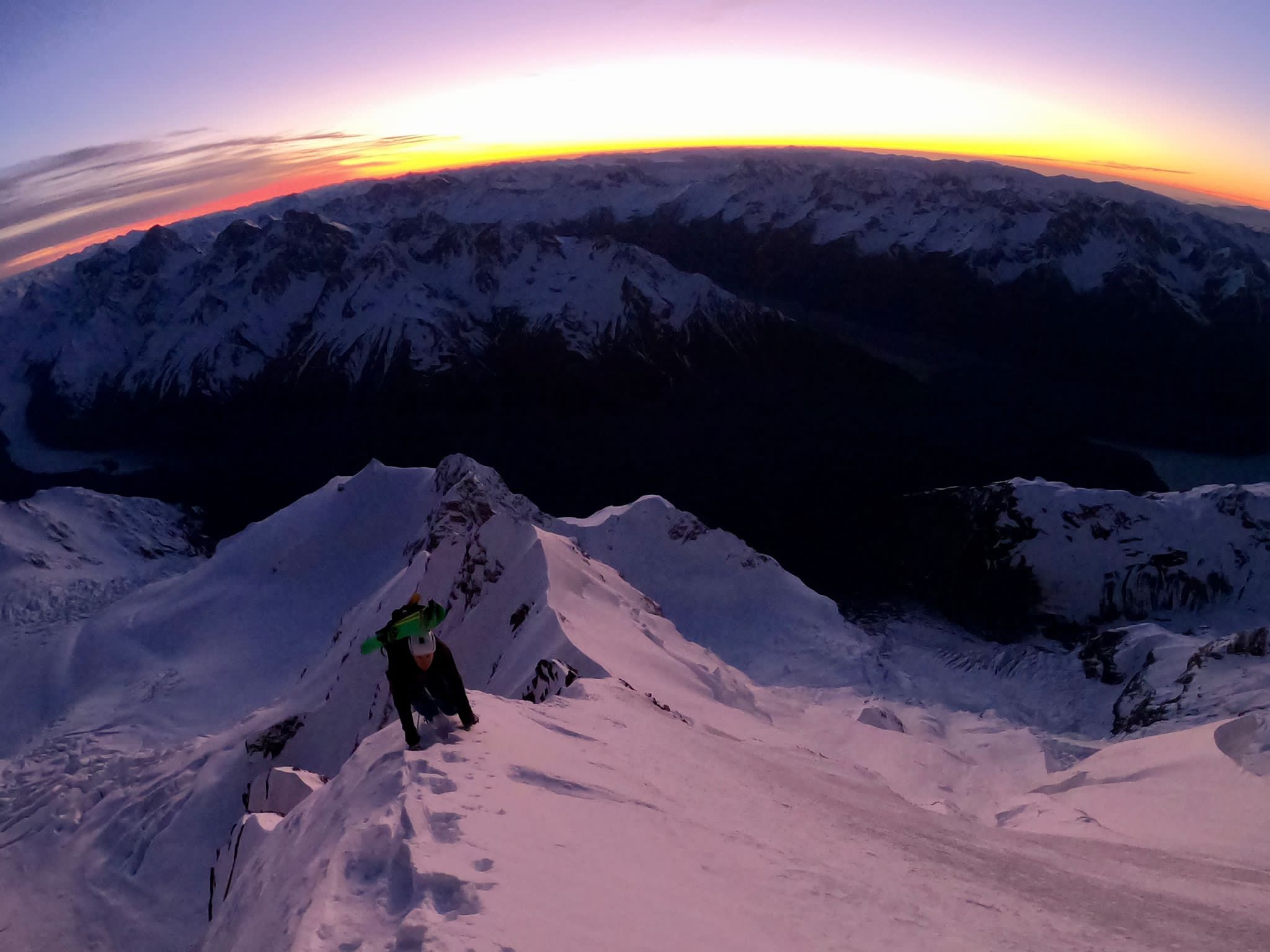
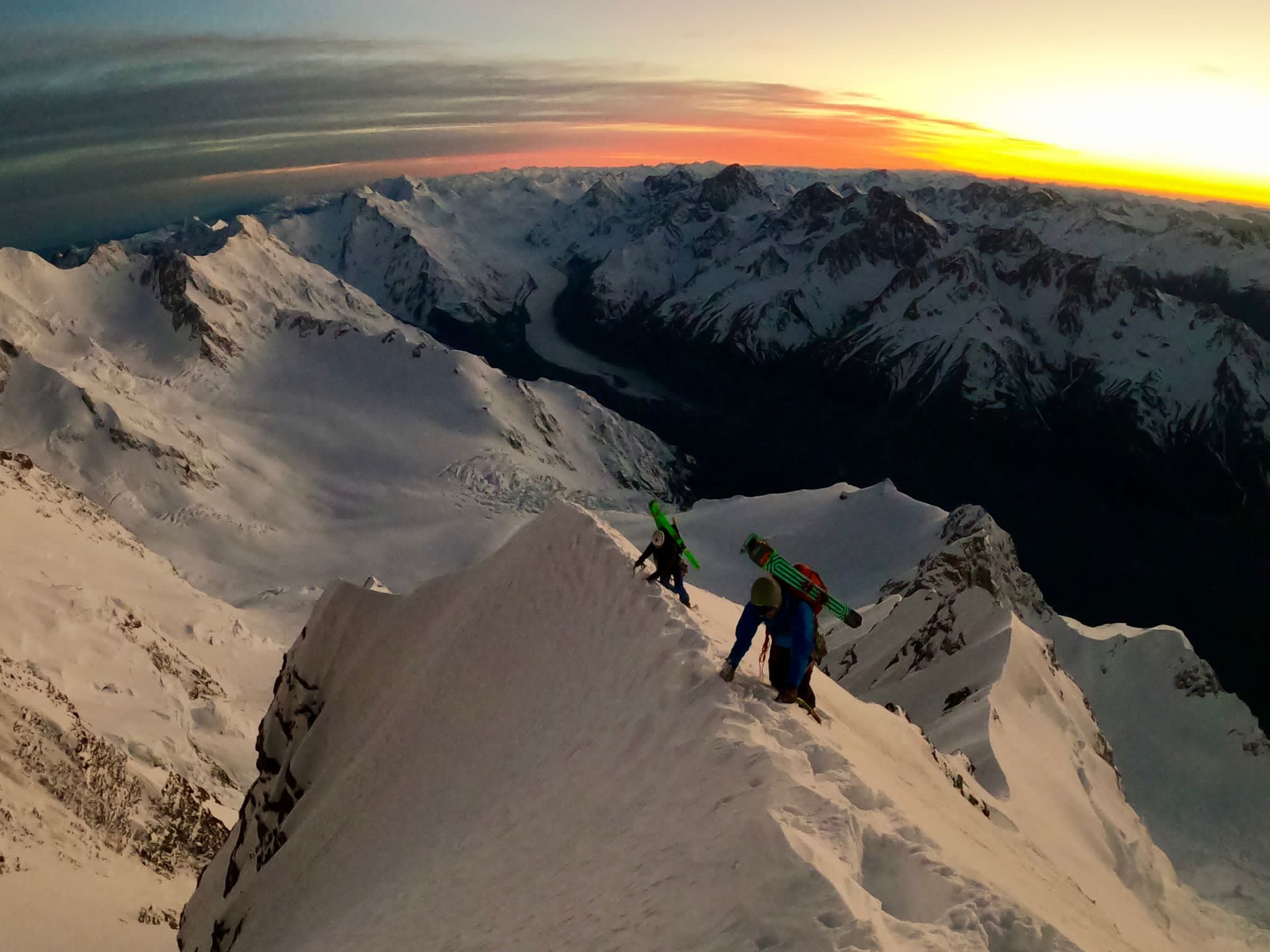
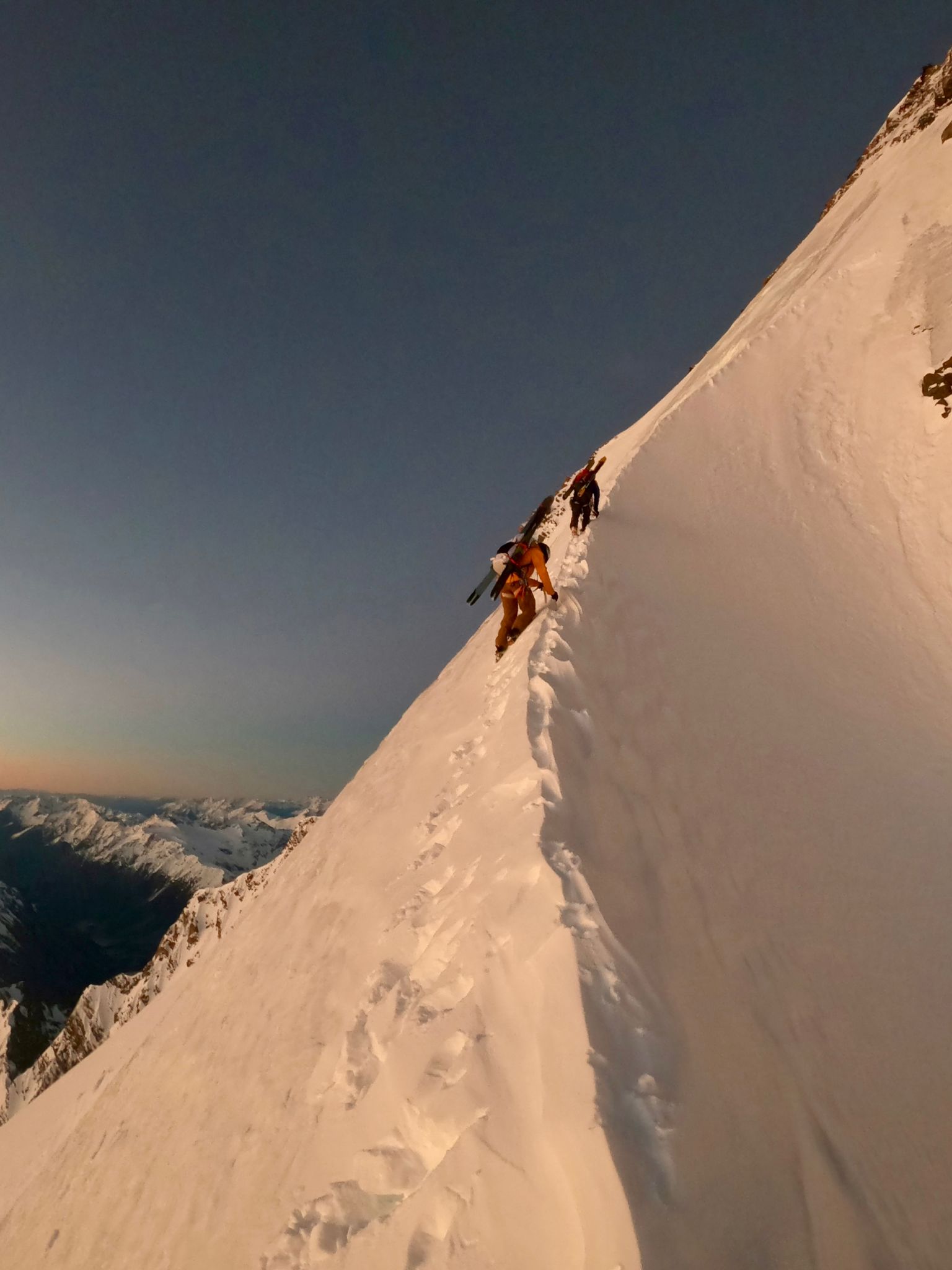
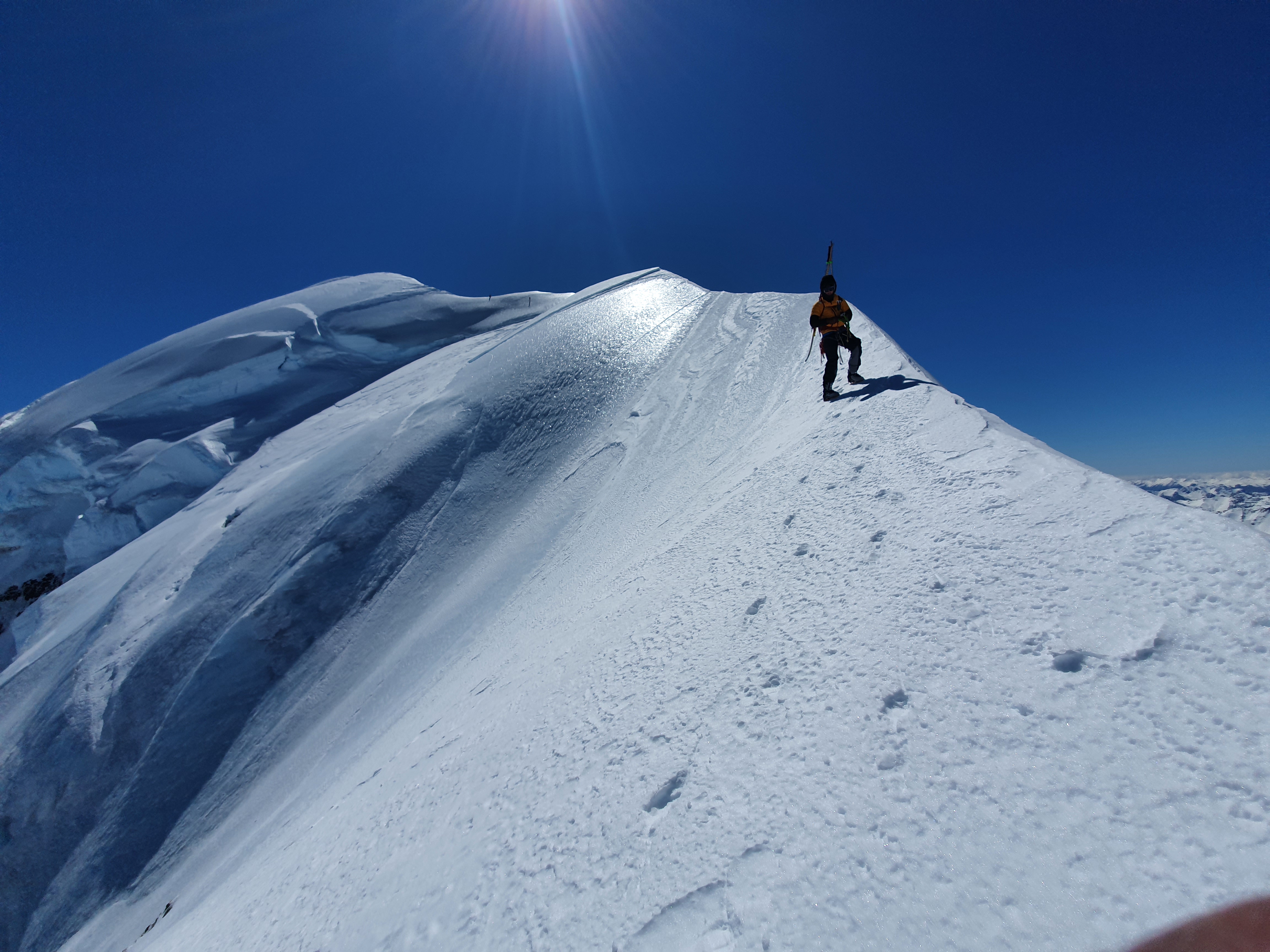
The first pitch is the steepest, around 55 degrees for a couple 100 metres. We then cut hard left for a long traverse to the feature we called ‘The Nose’. The traverse is pretty critical – from the photos we had some concern about ice on this section. A tool in each hand and screws ready to go to make an anchor and switch back to crampons if needed. The traverse takes you to the top of the nose.
This section wasn’t how it looked from the photos – was a lot wider and less sketchy than we were worried it might be, and the angle eases off to be similar to there E face at around 45 degrees. But it does mark the start of the serious overhead hazard which just gets worse from here on down. There are also a couple of bail out options here. If you can’t get through the nose, you can climb back up and right towards middle peak following the top part of the Clit Route. Or if you get through the nose but its looking bad underneath that, you can cut hard skiers left and could traverse back to the East ridge.
The skiing from the nose to the middle serac band was really incredible – shin to knee deepcold powder on consistent 45 degree slopes. Be sure to cut right at the bottom – finding the correct spot to rap the middle serac band is critical. Too for to skiers left and the cliff is 100s of meters of overhanging ice, too far right and you under the much more active and dangerous seracs.
2 V thread raps from here got us down to the lower snowfield. Speed is really of the essence from here on in, as you’re now under the maximum serac exposure. We managed to get our rope stuck on the final rap – knowing this was the last rap we just left one of our ropes behind in the interest of reducing time spent under the seracs. A momento left on the face and a good talking point for the scenic flights for the next few weeks! The last section involves cutting left to the major rib and then cutting down through the final cliff band. There are a few options to get through this and is another point to ID before starting down the line. Then straight-line down through the debris field across the Caroline Glacier and out of the firing line! It took us 2 hours from the summit to the bottom, and then a cruisey skin back up to ANZAC col and across to Plateau Hut, and some celebration beers.











 Peak Exposure